
Website & intake
Bring inquiries and customer intent into the CRM with context intact.
CrossMerg connects the systems behind your customer journey — CRM, websites, automation, portals, integrations, reporting, hosting, and ongoing support.
We put CRM at the center, then connect the tools, workflows, and support your team needs so customer information stays useful from first inquiry through delivery, payment, and follow-up.
Managed business systems, connected around your CRM
CrossMerg connects the systems that shape your customer journey and then stays involved to manage, improve, and support them. Instead of treating your website, CRM, workflows, client experience, reporting, and infrastructure as separate projects, we help them operate as one practical business system.
Operating center
Customer history, relationships, opportunities, active work, communication, and follow-through stay anchored to one source of truth.
Bring inquiries and customer intent into the CRM with context intact.
Move information and next steps forward without relying on memory or re-entry.
Keep approvals, updates, documents, billing, and support connected to the relationship.
Turn the same connected data into clearer decisions, ownership, and business visibility.
Managed by CrossMerg. Planning, implementation, integrations, hosting, support, and ongoing improvement stay connected to the system—not handed off after launch.
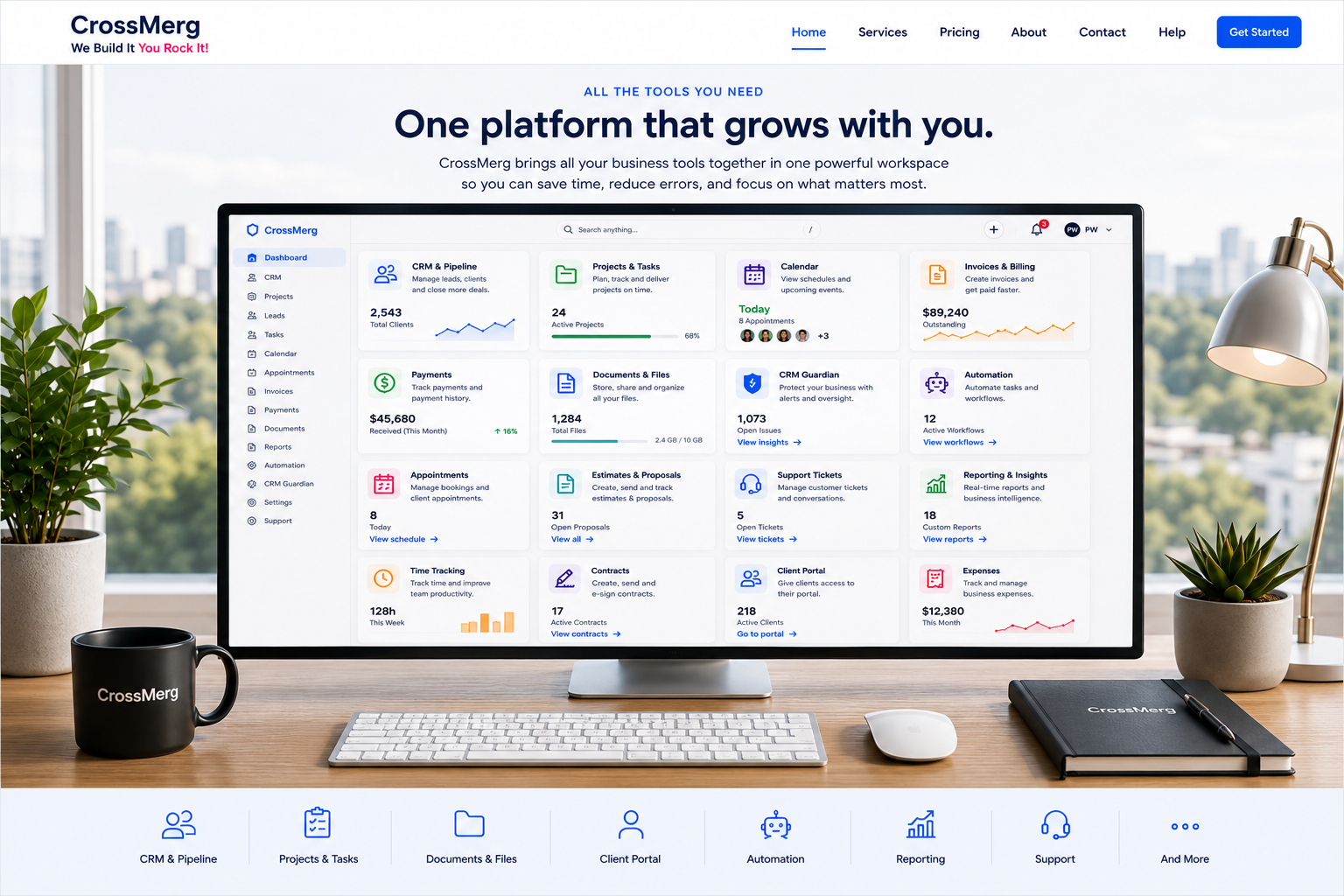
Customer context stays centered in the CRM while connected workflows make responsibility, status, and next steps easier to see.
Business result Less chasing and clearer next actions
Website activity, client communication, active work, approvals, and billing can move through one managed system instead of separate islands.
Business result Less duplicate entry and fewer gaps between teams
The same business information can support internal work and the client-facing experience, so updates feel coordinated rather than improvised.
Business result A calmer operation and a clearer customer journey
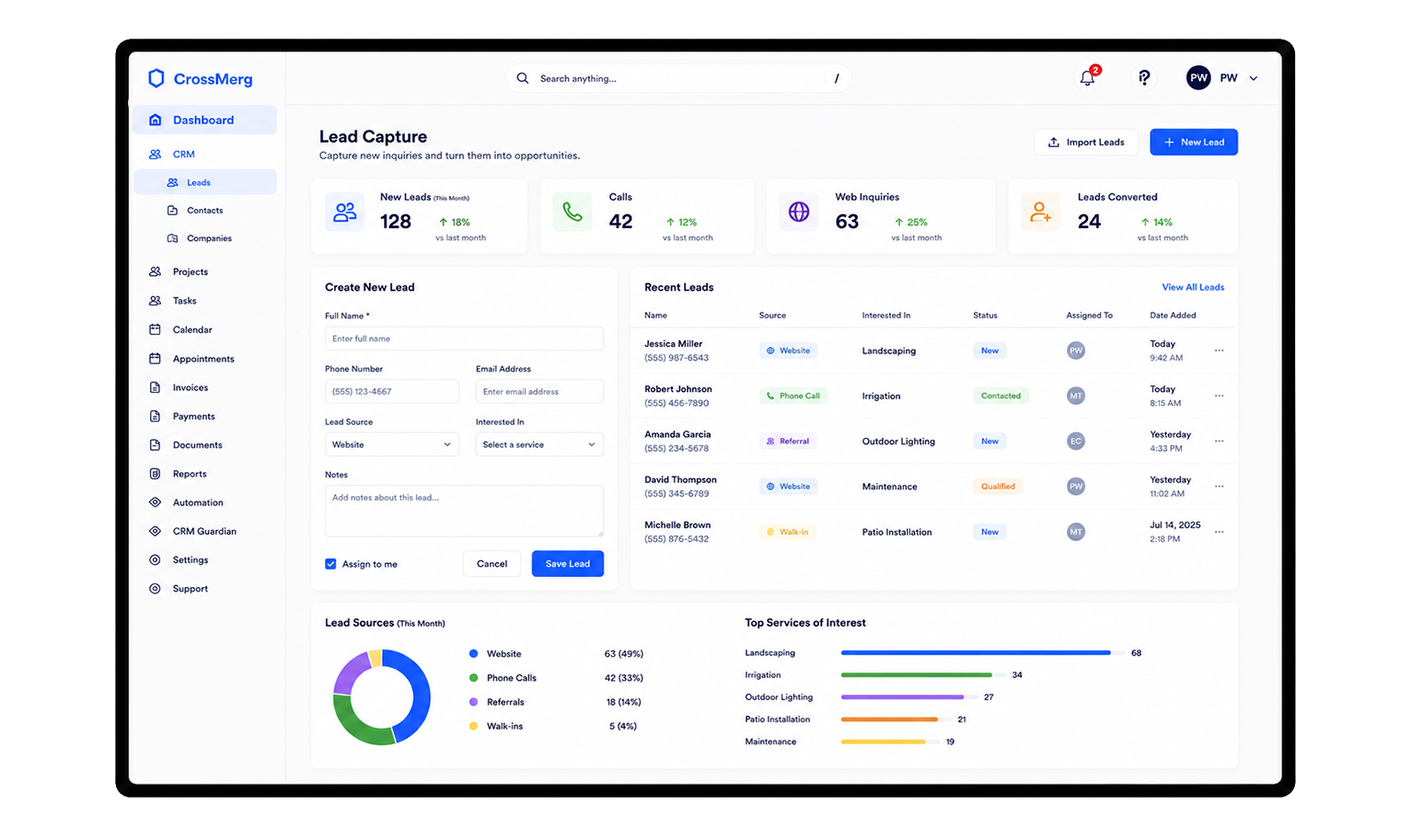
Inquiry & Intake
Website forms, calls, referrals, and other inquiries can enter a consistent intake flow so the CRM begins with the information your team actually needs.
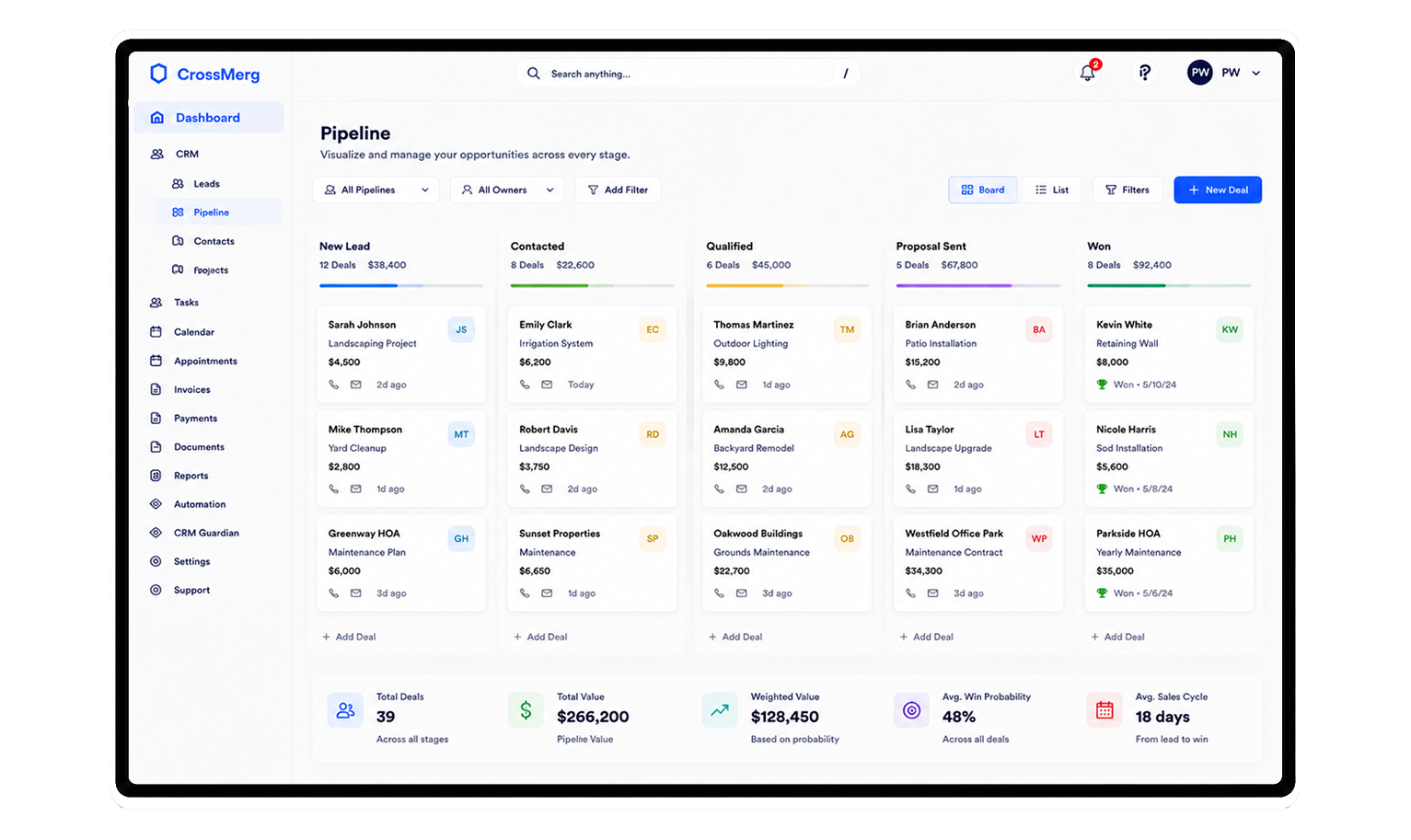
Pipeline & Follow-Up
Stages, ownership, reminders, and next actions stay connected to the same customer record, giving the team a shared view of what needs attention.
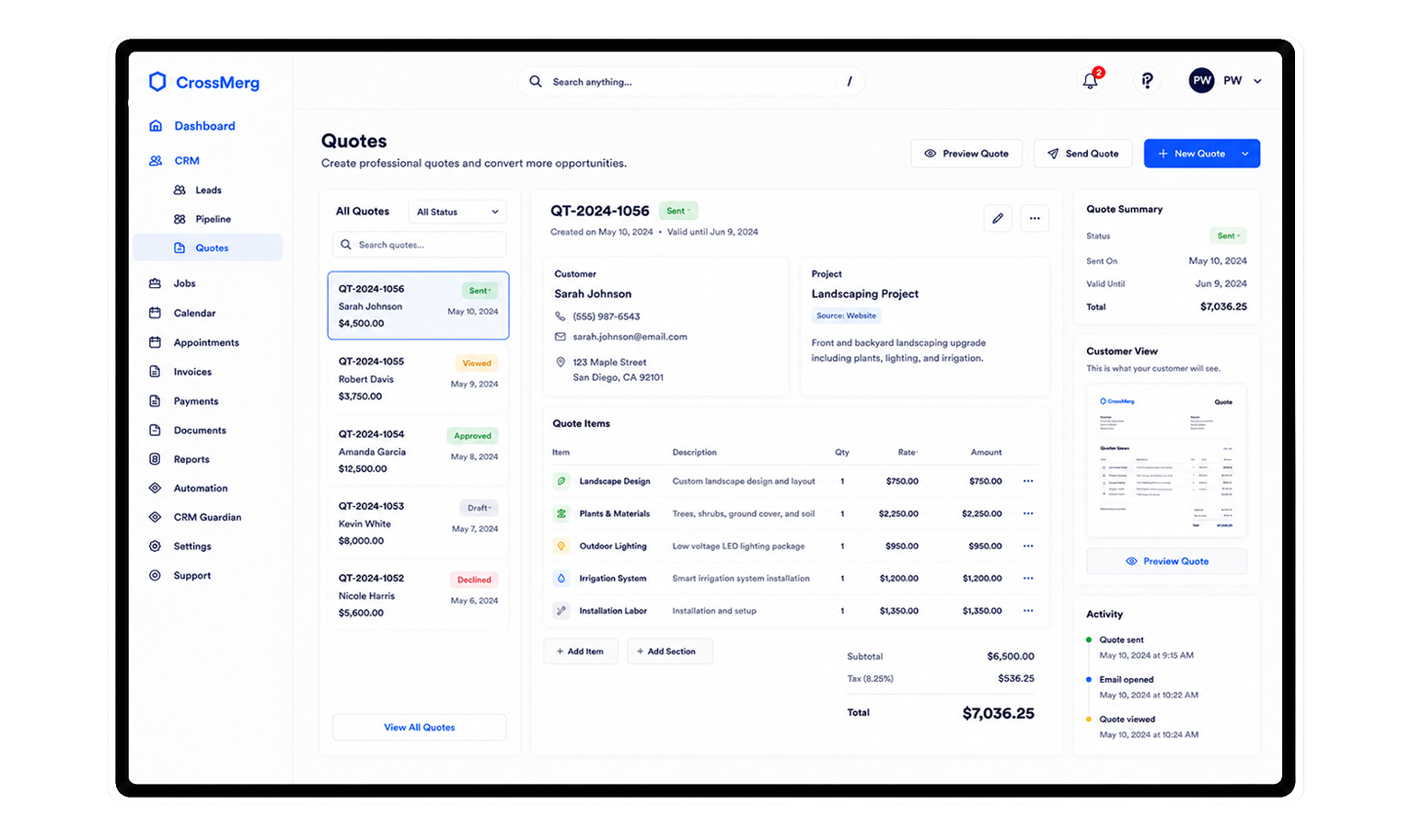
Proposal & Approval
Service options, pricing, approvals, files, and client responses stay tied to the relationship instead of becoming a separate process to reconcile later.
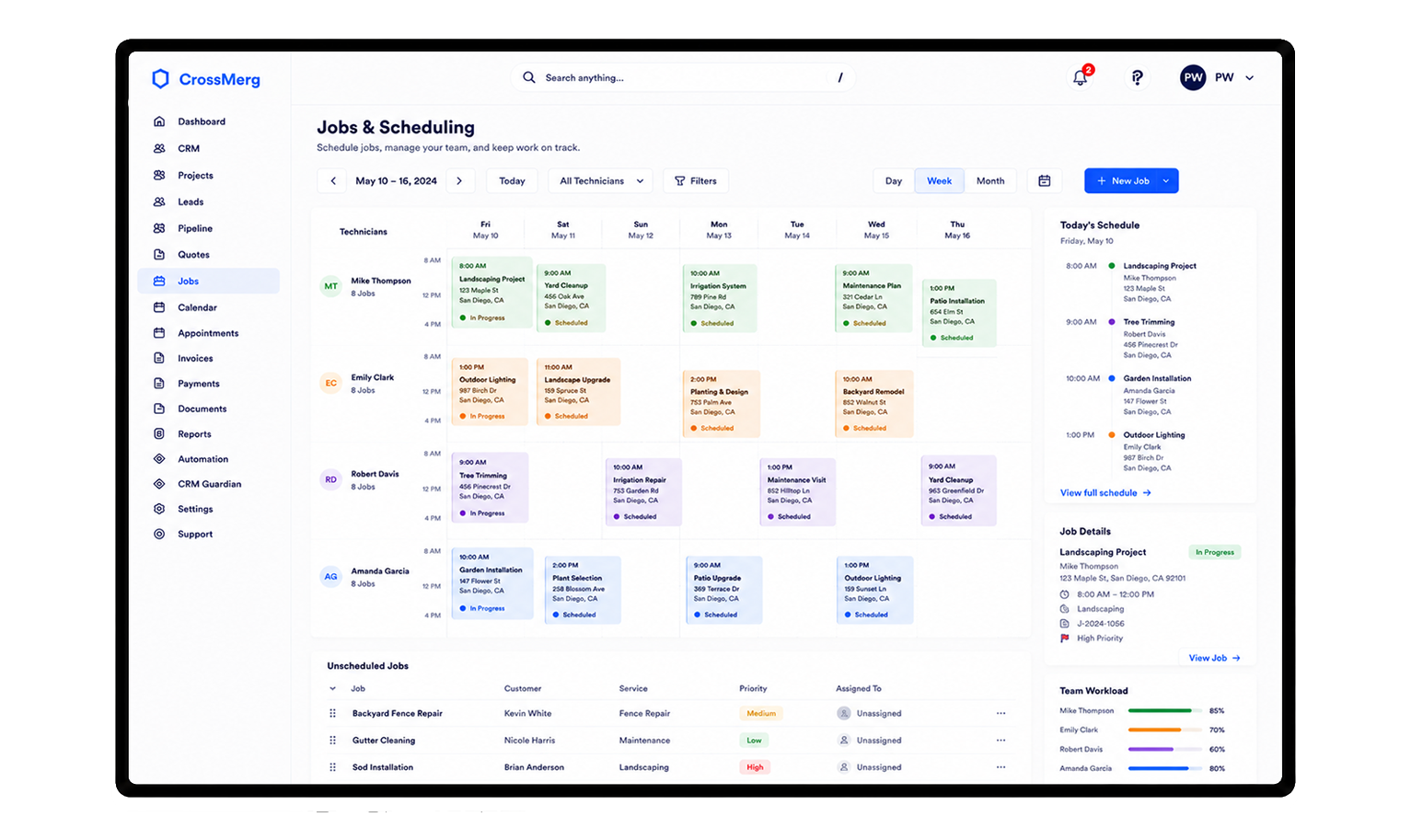
Delivery & Workflow
Scheduling, tasks, notes, files, internal handoffs, and automated steps can stay connected to the customer and the work already agreed upon.
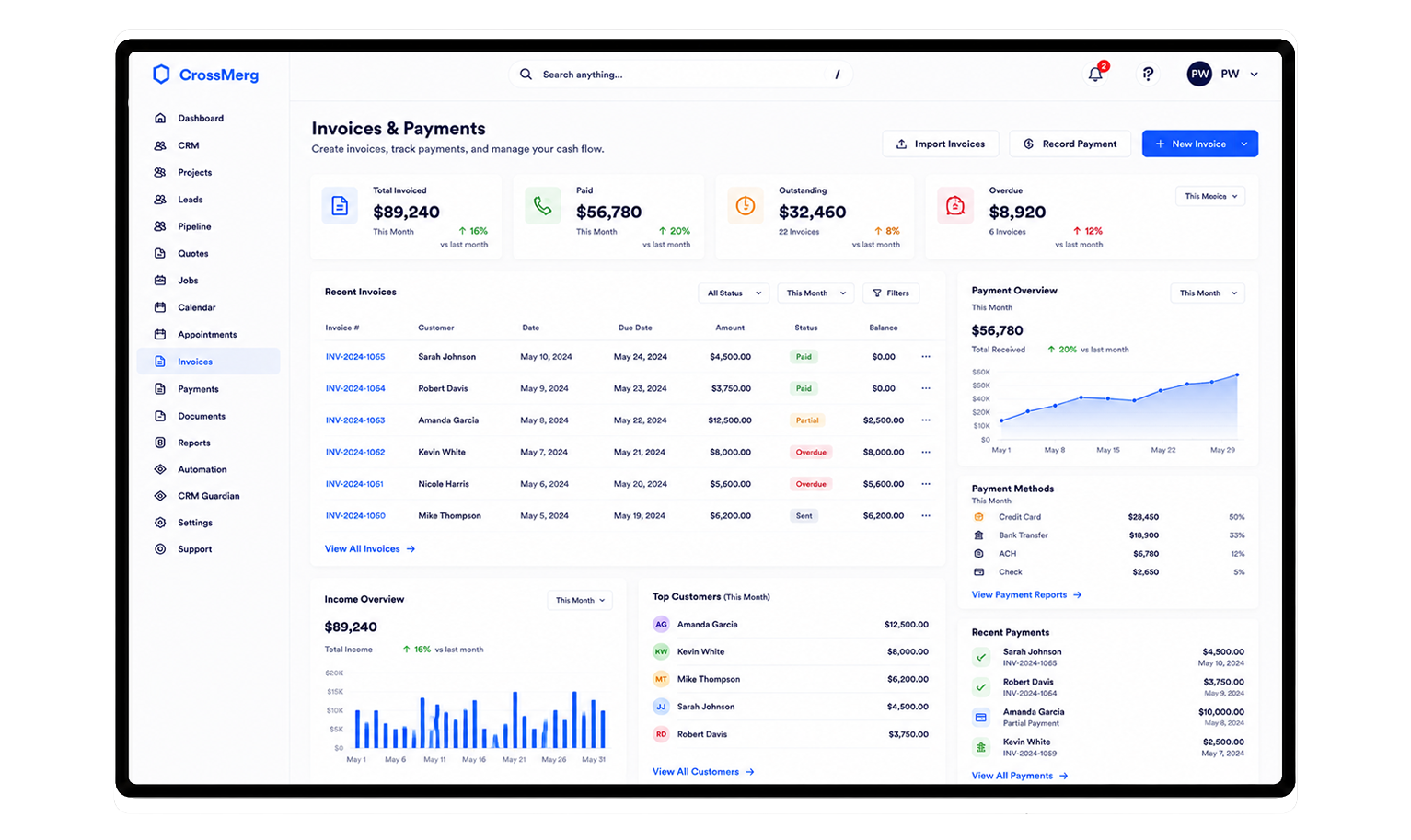
Billing & Client Follow-Through
Invoices, balances, payment status, documents, and client communication can stay attached to the same relationship instead of being reconstructed from separate systems.
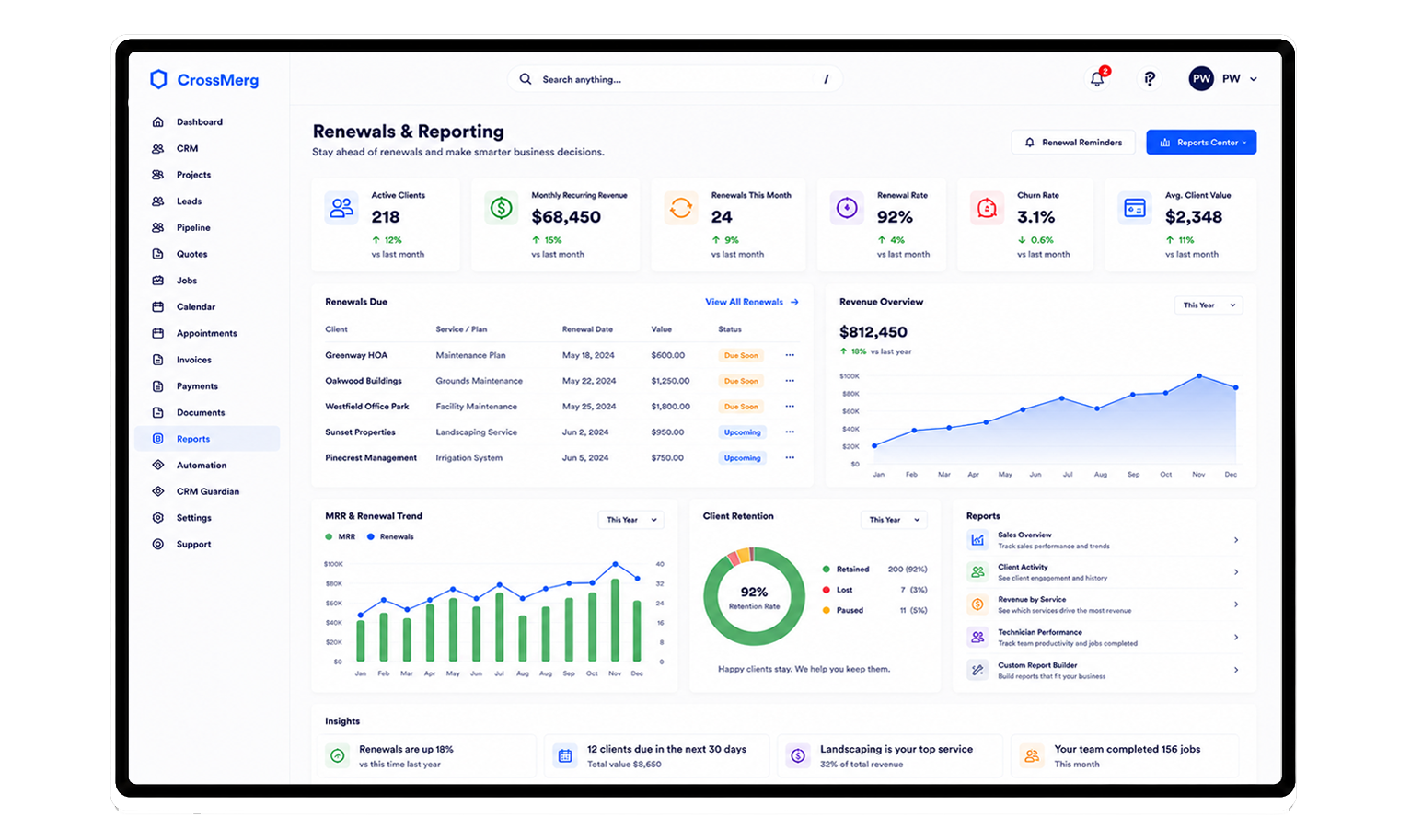
Retention & Insight
Renewal reminders, follow-up queues, operational reporting, and business intelligence turn connected customer history into practical next actions.
CRM-centered, not CRM-only
CrossMerg manages the CRM at the center and the connected systems around it—so your website, workflows, client experience, reporting, infrastructure, and support can work as one operating environment.
Customer system
Keep customer history, opportunities, work, billing, and follow-through centered in one managed operating system.
Digital experience
Connect the public-facing website and client-facing experience to the same customer journey instead of treating them as separate projects.
Connected work
Reduce duplicate entry and manual handoffs by connecting the tools, triggers, and repeatable steps around the CRM.
Decision support
Turn connected customer and operational data into practical visibility for owners, managers, and the people responsible for what happens next.
Managed foundation
Keep the system maintained after launch with managed infrastructure, technical support, updates, troubleshooting, and continuous improvement.
Planning & rollout
Choose the right starting point, shape the architecture, and roll out improvements in a sequence the business can actually absorb.
Who CrossMerg fits
The best fit is less about industry and more about how the business works: customers need responsive follow-through, staff need shared context, and owners need one dependable system instead of disconnected tools.
Keep inquiries, estimates, appointments, job details, photos, approvals, and payments connected from the office to the field.
Work moves through several handoffs, but the customer still expects one clear experience.
Give every client a clearer path from the first conversation through proposals, approvals, delivery, billing, and ongoing follow-up.
Client history, commitments, documents, and next steps need to stay visible across the team.
Coordinate schedules, reminders, customer records, service history, and follow-up without bouncing between disconnected tools.
The customer relationship continues before and after the appointment, not just while it is on the calendar.
Start with the workflow creating the most friction, then connect more of the business only when the team is ready for the next step.
Growth is exposing process gaps, but a large replacement project would create more disruption than value.
CrossMerg keeps CRM at the center and manages the surrounding website, workflows, integrations, reporting, hosting, and support as the business evolves.
Built around real service workflows
From the first inquiry to estimating, scheduling, field work, customer updates, invoicing, and follow-up, every handoff affects the customer experience. CrossMerg helps connect those moving parts around one dependable customer record.
One customer record underneath the workflow. Inquiries, estimates, appointments, job context, communication, billing, and follow-up can stay connected instead of becoming separate information trails.
Keep what already works. CrossMerg can connect useful scheduling, accounting, estimating, communications, and line-of-business tools around the customer relationship instead of forcing an unnecessary all-at-once replacement.
Start with the problem that matters most
CrossMerg is managed around measured improvement. We identify the clearest operational friction, keep what is already useful, put CRM at the center of the customer record, and connect the next system only when it earns its place.
Start with the workflow costing the team the most time, clarity, or customer follow-through instead of trying to redesign everything at once.
CrossMerg does not replace useful systems just to make the stack look simpler. We connect, improve, or retire tools only when there is a practical reason.
The rollout is shaped around your people, responsibilities, and capacity so the new process can become part of the day instead of another system to maintain.
CRM stays at the center while automation, client access, reporting, websites, integrations, or support are added only when they solve the next real business need.
What the first engagement looks like
We begin by understanding where customer or operational context is breaking down today. From there, we define the smallest useful improvement, decide what should remain connected to the CRM, and give the team a clear rollout path before deeper automation or expansion is considered.
Questions before you choose the next step
CrossMerg is a managed business systems partner with CRM at the center. The goal is not to replace everything you use; it is to make the customer-facing and operational pieces work together more reliably.
You do not need to know which CrossMerg service you need. Start with the workflow, handoff, or customer experience that is creating the most drag.
A useful website, accounting platform, scheduling tool, or line-of-business system can stay in place while we connect the missing pieces around the CRM.
Planning, configuration, integrations, rollout, hosting, support, and ongoing improvement can stay with one managed business systems partner.
Automation, portals, reporting, websites, integrations, and deeper support are added when the next connection produces clear practical value.
No. CrossMerg is designed to improve the parts of your workflow that create the most friction. Useful systems can remain in place while we connect, simplify, or replace only what is holding the team back.
No. It is especially useful for small and growing service businesses that need clearer customer follow-through without adding more administrative work. The starting scope can remain intentionally small.
Yes. CrossMerg is fully managed. We help plan the workflow, configure the system, support the rollout, and remain available for ongoing improvements, training, and technical assistance.
Yes. CrossMerg can build and manage the website, CRM, customer workflows, hosting, and related integrations so the public-facing experience and the internal system work together.
The timing depends on the scope, but the first step is usually a focused review of the most important friction point. Smaller improvements can often begin without waiting for a complete business-wide rebuild.
No long-term contract is required for standard CrossMerg services. The recommended structure, hosting, support, and any project-specific commitments are explained clearly before work begins.
A practical first conversation
Tell us where the day feels harder than it should. We can look at the customer journey, the CRM at the center of it, and the surrounding website, workflows, integrations, reporting, hosting, or support to identify the smallest practical next step.
What we can review together
Identify the workflow, handoff, or customer experience creating the most friction today.
Review what should stay, what should connect to the CRM, and what genuinely needs to change.
Choose one focused improvement—or a broader managed systems plan—based on what creates the clearest value first.
The next step is simply to talk through what is happening today and decide what is worth improving first.
We will help you determine whether the right next step is CRM work, a website improvement, automation, integration, reporting, infrastructure, support, or simply a clearer plan—and keep the solution proportional to the problem.
Why businesses trust CrossMerg
We help teams improve the client experience without adding unnecessary complexity, forcing a large migration, or losing sight of how the business actually works.
Practical value
Founder perspective
How we work
Client-first language
We translate internal workflow into simple client-facing steps that reduce friction.
Lightweight rollout
Start with one feature before rolling out deeper portal options.
Works with your reality
We respect your team size, tools, and capacity — no forced big-bang migrations.