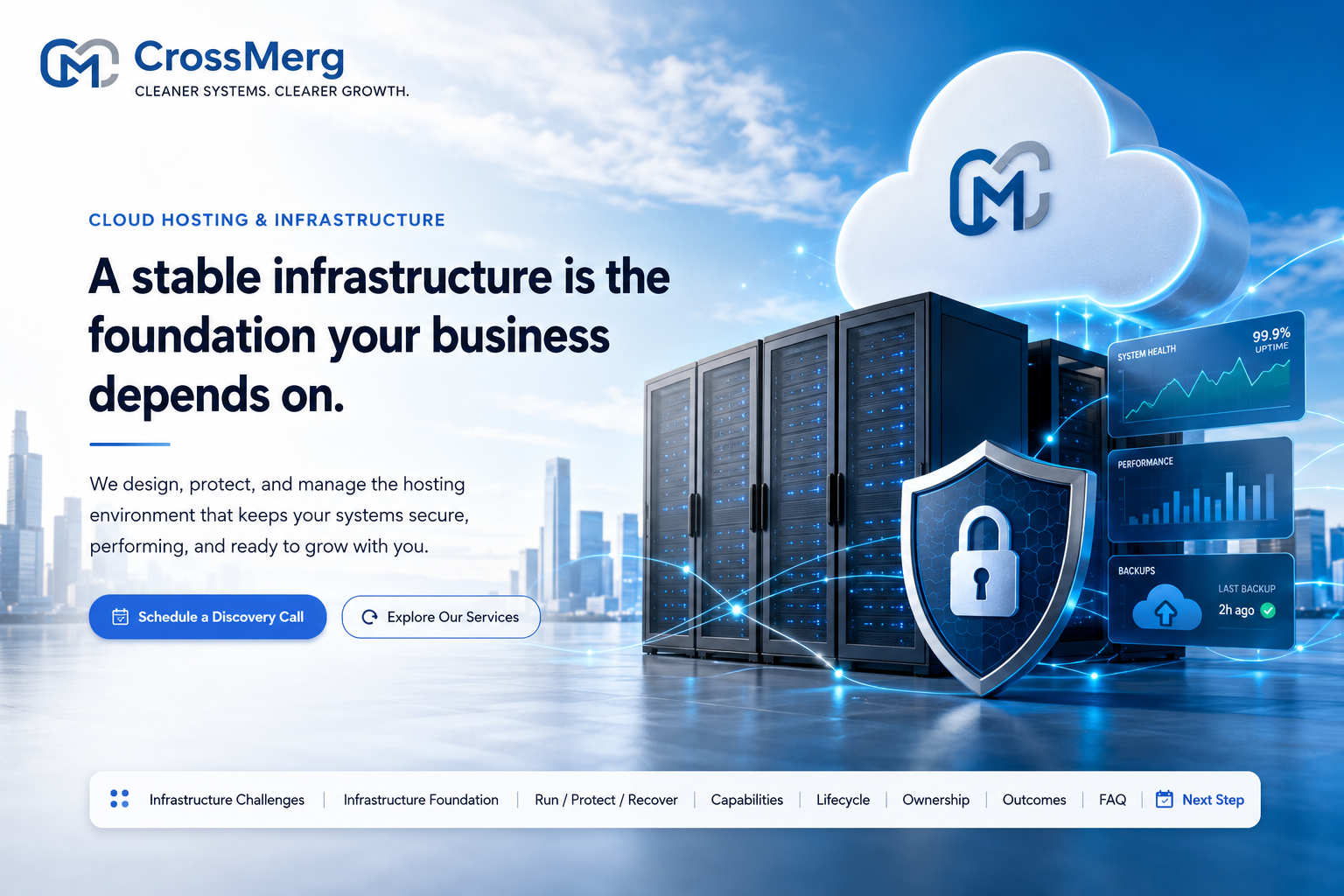
Cloud Hosting & Infrastructure

Hosting • Performance • Security • Backups • Monitoring

Reliable infrastructure for the systems your business depends on.

CrossMerg helps keep the hosting, application, database, security, backup, and monitoring foundation behind your business systems dependable—so your team can focus on the work those systems support.

Reliable environments Protected business systems Practical recovery planning
Cloud hosting and infrastructure environment with secure servers, monitoring, backups, and cloud protection

When infrastructure becomes an invisible risk

The systems people see depend on infrastructure most people never do.

Hosting problems rarely begin with one dramatic failure. More often, responsibility, performance, backups, access, monitoring, and dependencies become harder to manage a little at a time.

The environment grew without a clear infrastructure plan

Websites, CRM systems, databases, integrations, and supporting services were added over time without one documented hosting and operations model.

Business impact Responsibility becomes unclear and routine changes carry more risk.

Performance problems are treated only after users notice them

Slow pages, database pressure, storage limits, or resource contention can build gradually before anyone knows where the bottleneck actually is.

Business impact Teams lose time troubleshooting symptoms instead of addressing the underlying constraint.

Security responsibilities are spread across too many places

Domains, certificates, accounts, application access, hosting panels, updates, and network controls may all be managed separately.

Business impact Small configuration gaps can become larger operational or security risks.

Backups exist, but recovery has not been thought through

A backup schedule is useful only when the right data is captured, retention is appropriate, restore paths are understood, and someone knows what happens next.

Business impact A failure can turn into a longer outage because recovery decisions begin too late.

Problems are discovered through customer or staff reports

Without useful monitoring, availability, storage, certificates, resource pressure, and application conditions may go unnoticed until someone is already affected.

Business impact Infrastructure becomes reactive instead of observable.

Nobody owns the complete operating picture

Hosting vendors may manage the platform while application vendors manage software, leaving the business responsible for coordinating the space between them.

Business impact Incidents take longer to diagnose because ownership begins with handoffs.

Build the operating foundation first

Reliable infrastructure is a combination of hosting, protection, visibility, and recovery.

CrossMerg treats the environment as one operating system around the application—so compute, data, access, backups, monitoring, and maintenance support the same business outcome.

  1. 01

    Hosting & compute

    Choose and configure an environment that fits the application, expected usage, operational needs, and realistic growth path.

  2. 02

    Performance & availability

    Structure hosting, application, database, caching, and resource decisions around dependable day-to-day use rather than theoretical capacity.

  3. 03

    Security & access

    Reduce unnecessary exposure through sensible account, certificate, application, environment, and maintenance practices.

  4. 04

    Data & backups

    Protect the files, databases, configuration, and business records needed to restore useful service after a failure or unwanted change.

  5. 05

    Monitoring & visibility

    Watch the conditions that matter so emerging availability, certificate, capacity, storage, or application issues are easier to recognize.

  6. 06

    Maintenance & recovery

    Keep routine infrastructure work, updates, documentation, recovery expectations, and operational follow-up part of the service—not an afterthought.

Run • Protect • Recover

Infrastructure should work normally, resist avoidable problems, and have a path back when something fails.

These three responsibilities keep the service grounded in day-to-day operation rather than treating hosting as a one-time setup project.

Run

Keep the environment dependable during normal operation.

Maintain the hosting, configuration, availability, storage, application support, and routine operational foundation the business relies on.

  • Environment health
  • Capacity awareness
  • Routine maintenance
  • Configuration discipline
Protect

Reduce exposure and identify problems earlier.

Use layered access, certificates, updates, monitoring, backup controls, and operational checks to reduce avoidable infrastructure risk.

  • Access controls
  • SSL/TLS
  • Patch awareness
  • Backup protection
Recover

Have a practical path back when something fails.

Design recovery around the systems and data the business actually needs, with clear restore priorities, dependencies, and next steps.

  • Restore priorities
  • Data recovery
  • Service dependencies
  • Recovery decisions

Infrastructure capabilities

Manage the environment around the application, not only the place where its files live.

The right scope depends on the system, but these are the common infrastructure responsibilities that often need to work together for dependable operation.

Managed infrastructure scope

Bring the operating layers into one understandable service picture.

Coordinated scope
Hosting environment

A dependable place for business systems to run.

Hosting and application environments should match the workload, administrative needs, security expectations, and growth path of the system they support.

  • Cloud and web hosting
  • Application hosting
  • Environment configuration
  • Storage and resource planning
Data & continuity

Protect the information that makes the system useful.

Databases, application files, configuration, and critical business records need a backup and recovery model that fits their importance.

  • Database environments
  • Backup schedules
  • Retention planning
  • Restore and recovery support
Security & access

Keep infrastructure access intentional and maintainable.

Security improves when account ownership, certificates, environment access, updates, and administrative practices are treated as one operating concern.

  • SSL/TLS management
  • Account and access review
  • Update coordination
  • Environment isolation
Monitoring & maintenance

See important changes before they become avoidable surprises.

Useful monitoring and recurring maintenance help turn infrastructure from a hidden dependency into an environment that can be managed deliberately.

  • Availability monitoring
  • Resource and storage checks
  • Certificate awareness
  • Operational maintenance
Migration & change

Move systems without treating migration as a file-copy exercise.

A dependable migration accounts for application behavior, data, DNS, certificates, dependencies, testing, rollback, and cutover timing.

  • Existing-site migration
  • CRM/application migration
  • DNS and cutover planning
  • Validation and rollback planning
Connected operations

Support the services around the application—not only the server.

Domains, DNS, integrations, email-related infrastructure, scheduled jobs, APIs, and external services can all affect whether the main system works as expected.

  • DNS and domains
  • Scheduled services
  • Integration dependencies
  • Supporting infrastructure

One operating picture

Hosting + DNS + SSL + data + monitoring + maintenance + recovery context

The objective is not to make every technology identical. It is to make the infrastructure responsibilities easier to see, coordinate, and operate together.

Infrastructure lifecycle

A dependable environment is not finished at deployment.

CrossMerg treats infrastructure as an operating lifecycle: understand the environment, design intentionally, deploy carefully, watch what matters, maintain the foundation, and improve it as the business changes.

Continuous infrastructure management

Move through a repeatable operating cycle instead of waiting for the next infrastructure problem.

Continuous cycle
  1. 01

    Assess

    Understand the current environment, systems, dependencies, access, risks, performance concerns, and recovery expectations.

  2. 02

    Design

    Define the hosting, security, backup, monitoring, ownership, and recovery model that fits the actual business need.

  3. 03

    Deploy

    Configure or migrate the environment carefully, validate dependencies, and establish the operating baseline.

  4. 04

    Monitor

    Watch useful service, capacity, certificate, backup, and infrastructure conditions so important changes are visible.

  5. 05

    Maintain

    Handle routine updates, housekeeping, backup review, documentation, and infrastructure administration deliberately.

  6. 06

    Improve

    Refine capacity, resilience, security, performance, and operational practice as the applications and business evolve.

Review triggers

Know what should send the environment back through the lifecycle.

Usage or capacity changes

Growth in users, traffic, storage, database activity, background work, or integration volume can change the right infrastructure decisions.

Application or dependency changes

New modules, integrations, APIs, authentication, scheduled jobs, or supporting services can introduce new infrastructure dependencies.

Security or access changes

New users, vendors, certificates, domains, application exposure, or administrative access should prompt a review of the operating boundary.

Incidents and recovery lessons

Slowdowns, outages, failed jobs, backup issues, or restore events should feed practical improvements back into the environment.

Built for the connected environment

Infrastructure is the operating foundation beneath the rest of the business stack.

CrossMerg can look beyond a single server because the hosted environment often supports CRM, websites, client portals, automation, integrations, reporting, and other connected services at the same time.

Connected infrastructure view

See the dependencies around the system before changing one of them.

Operating foundation

CRM

Customer records, workflows, automations, staff access, and daily operations depend on stable application and database infrastructure.

Websites

Public sites rely on hosting, DNS, certificates, application performance, storage, and dependable deployment practices.

Client portals

Authenticated customer experiences need availability, security, data access, and predictable application performance.

Automation

Background jobs, integrations, scheduled actions, APIs, and webhooks depend on the infrastructure around the workflow.

Integrations

Connected systems often rely on DNS, certificates, endpoints, credentials, scheduled services, and reliable application access.

Reporting

Dashboards and reporting depend on database health, timely data access, application performance, and the availability of source systems.

Clear ownership reduces operating friction

Define who operates the infrastructure, who controls the business decisions, and where both sides need to coordinate.

Managed infrastructure works best when responsibility is visible before a change, incident, or vendor handoff occurs. CrossMerg can own the agreed technical operating scope while your team retains authority over business priorities and material decisions.

Responsibility model

Separate operational ownership from business authority without creating gaps between them.

Defined ownership

Technical operating scope

CrossMerg manages

  • Hosting and environment configuration within the agreed service scope
  • Infrastructure monitoring, maintenance, backup, and recovery planning
  • Technical coordination across hosting, application, DNS, certificates, and supporting services
  • Infrastructure recommendations as systems, usage, risk, or business needs change

Business authority

Your team controls

  • Business priorities, application usage, users, content, data decisions, and operational policy
  • Approval of material migrations, service changes, maintenance windows, and recovery tradeoffs
  • Internal user access decisions and business ownership of the systems being hosted
  • The business context that determines which systems and data are most critical

Where coordination matters

Some infrastructure decisions need both technical context and business approval.

Material environment changes

Major platform, hosting, database, domain, integration, or infrastructure changes should combine technical review with business timing and approval.

Maintenance and change windows

CrossMerg can recommend the technical window, while your team confirms the business impact, customer timing, and operational constraints.

Access and vendor decisions

Administrative access, third-party support, credential ownership, and vendor involvement should be explicit before elevated access is granted.

Risk and recovery choices

Recovery priorities, restore points, downtime tolerance, and higher-risk changes require both technical feasibility and business acceptance.

Operating outcome

Clear technical scope + clear business authority + clear coordination points

That structure reduces ambiguity during routine changes, vendor handoffs, maintenance, incidents, and recovery decisions.

Practical infrastructure outcomes

The value is not the server. It is a more dependable foundation for the systems your business relies on.

CrossMerg helps reduce infrastructure friction, clarify ownership, improve recovery readiness, and make the technical foundation easier to operate as your applications and business needs change.

Greater reliability

More dependable systems

Reduce avoidable hosting and infrastructure instability by operating from a clearer, better-maintained foundation.

Less operational friction

Less infrastructure distraction

Give staff and leadership fewer reasons to spend time coordinating hosting, certificates, backups, or recurring technical issues.

Clearer recovery path

Better recovery readiness

Make backup and restore expectations clearer before a failure forces the business to make recovery decisions under pressure.

Better user experience

More consistent performance

Align resource, application, database, storage, and maintenance decisions with the way the systems are actually used.

Lower avoidable risk

Stronger operational security

Reduce configuration drift and unnecessary exposure by treating access, certificates, updates, backups, and environment practices together.

More adaptable infrastructure

A foundation that can grow

Make future changes easier by keeping infrastructure documented, maintainable, and connected to real application and business needs.

From infrastructure friction to managed operations

Move from reacting to infrastructure problems toward operating a clearer technical foundation.

Before

Hosting treated as a one-time setup task

With CrossMerg

Infrastructure managed as an operating lifecycle

Before

Problems discovered after users are affected

With CrossMerg

Monitoring and review designed around early visibility

Before

Backups exist but recovery expectations are unclear

With CrossMerg

Backup, restore, and recovery priorities are part of the operating model

Before

Vendor and technical ownership is ambiguous

With CrossMerg

Technical scope, business authority, and escalation paths are defined

Before

Capacity changes happen only after performance degrades

With CrossMerg

Usage, growth, and dependency changes trigger reassessment

Before

Infrastructure work interrupts the business unexpectedly

With CrossMerg

Changes are coordinated around risk, timing, and operational impact

Cloud Hosting & Infrastructure outcome

Clearer ownership → Better visibility → Stronger recovery readiness → Fewer infrastructure surprises

The goal is a technical foundation that supports the business quietly and predictably instead of becoming another source of operational uncertainty.

Questions before you start

Choose the right layer of help before changing the infrastructure underneath your business systems.

Cloud Hosting & Infrastructure is the right starting point when the core problem is hosting, availability, security, backups, recovery, monitoring, migration, or the technical environment supporting your applications.

Service decision guide

Which CrossMerg service is closest to the problem you are trying to solve?

Best fit for this page

Cloud Hosting & Infrastructure

You need a more dependable hosting, security, backup, monitoring, recovery, or infrastructure operating foundation.

Manage the CRM layer

Managed CRM Services

The CRM is already running and you need ongoing administration, operational support, maintenance, and improvement of the CRM itself.

Build the application foundation

CRM Implementation

You first need the CRM structure, fields, stages, permissions, workflows, and launch configuration built correctly.

Connect the systems

Integrations

Your main problem is getting applications, data, APIs, and business systems to exchange information reliably.

Simple decision rule

Start with the layer where the uncertainty lives.

If the uncertainty is the hosting environment, recovery, availability, infrastructure ownership, or migration path, start here. If it is primarily application configuration, CRM operations, or system-to-system data movement, the adjacent service may be the better first step.

Common infrastructure questions

Open the question closest to the concern you are trying to resolve.

8 answers
What does managed cloud hosting include?

The exact scope depends on the environment, but it can include hosting configuration, application and database support, SSL/TLS, DNS coordination, backups, monitoring, routine maintenance, resource review, migrations, and recovery planning. We define responsibilities clearly so you know what CrossMerg is managing and what remains with your team or another provider.

Can CrossMerg host an existing website, CRM, or business application?

Often, yes. We first review the application requirements, current hosting, database, storage, DNS, certificates, integrations, scheduled services, and vendor constraints. If the system is a good fit, we can plan the environment and migration around those dependencies rather than treating the move as a simple copy.

Do you manage backups?

Backup management can be part of the service. We focus on what needs to be protected, how often it should be captured, appropriate retention, where recovery copies live, and what the restore path should look like. A backup is most useful when recovery expectations are also understood.

Can you migrate a system from another hosting provider?

Yes, when the application and provider constraints allow it. A migration plan can include files, databases, DNS, certificates, integrations, scheduled jobs, testing, cutover timing, validation, and rollback considerations so the move is controlled rather than improvised.

How is hosting security handled?

Security is layered. Depending on scope, that may include access controls, account hygiene, SSL/TLS, updates, environment configuration, isolation, backup protection, monitoring, and coordination with application-level security. No single setting replaces good operational practice across the stack.

Can the environment scale as our business grows?

That is part of the planning goal. We look at the application, expected usage, database behavior, storage, integrations, operational load, and realistic growth path. Scaling may involve resource changes, architecture changes, application work, or all three, so we avoid promising that infrastructure alone solves every growth constraint.

What happens if something goes down?

The response depends on the cause and agreed service scope. Monitoring and operational visibility help identify the condition, while documented dependencies, backups, recovery priorities, and provider coordination make the next actions clearer. The goal is to reduce diagnosis and recovery friction before an incident occurs.

Do all of our applications need to be hosted by CrossMerg?

No. Some businesses need CrossMerg to manage a specific application or environment while other systems remain with existing providers. We can define a practical boundary and coordinate around the dependencies that cross that boundary.

Build a more dependable infrastructure foundation

Give the systems your business relies on a clearer operating home.

We’ll review your current hosting environment, infrastructure dependencies, recovery expectations, operational pain points, and ownership gaps—then recommend the simplest practical path toward a more dependable, understandable, and manageable foundation.

Clearer protection Stronger recovery readiness Better operating visibility

Why businesses trust CrossMerg

Practical systems. Clear ownership. Human support.

We help teams improve the client experience without adding unnecessary complexity, forcing a large migration, or losing sight of how the business actually works.

Practical value

Why teams choose CrossMerg

  • Fewer status calls because clients can see what’s happening.
  • Faster approvals because the next step is obvious.
  • Cleaner payments because invoices have context and history.
  • A more professional client experience without enterprise complexity.

Founder perspective

A note from the founder of CrossMerg

If you tell us what your clients struggle with today — approvals, payments, scheduling, status updates, or disconnected processes — we’ll recommend the smallest practical step that can make a meaningful difference.

We focus on improvements teams can actually adopt, not abstract features that look impressive in a demo but create more complexity in day-to-day operations.

Our starting point Find the smallest practical improvement that creates meaningful value.

How we work

How we build better client experiences

Client-first language

We translate internal workflow into simple client-facing steps that reduce friction.

Lightweight rollout

Start with one feature before rolling out deeper portal options.

Works with your reality

We respect your team size, tools, and capacity — no forced big-bang migrations.

Start small and expand later. No long-term contracts or surprise fees. Built and supported by a small, US-based team.