01
Launch
The CRM matches the plan
Fields, workflows, permissions, reports, and user roles are aligned to the agreed implementation.
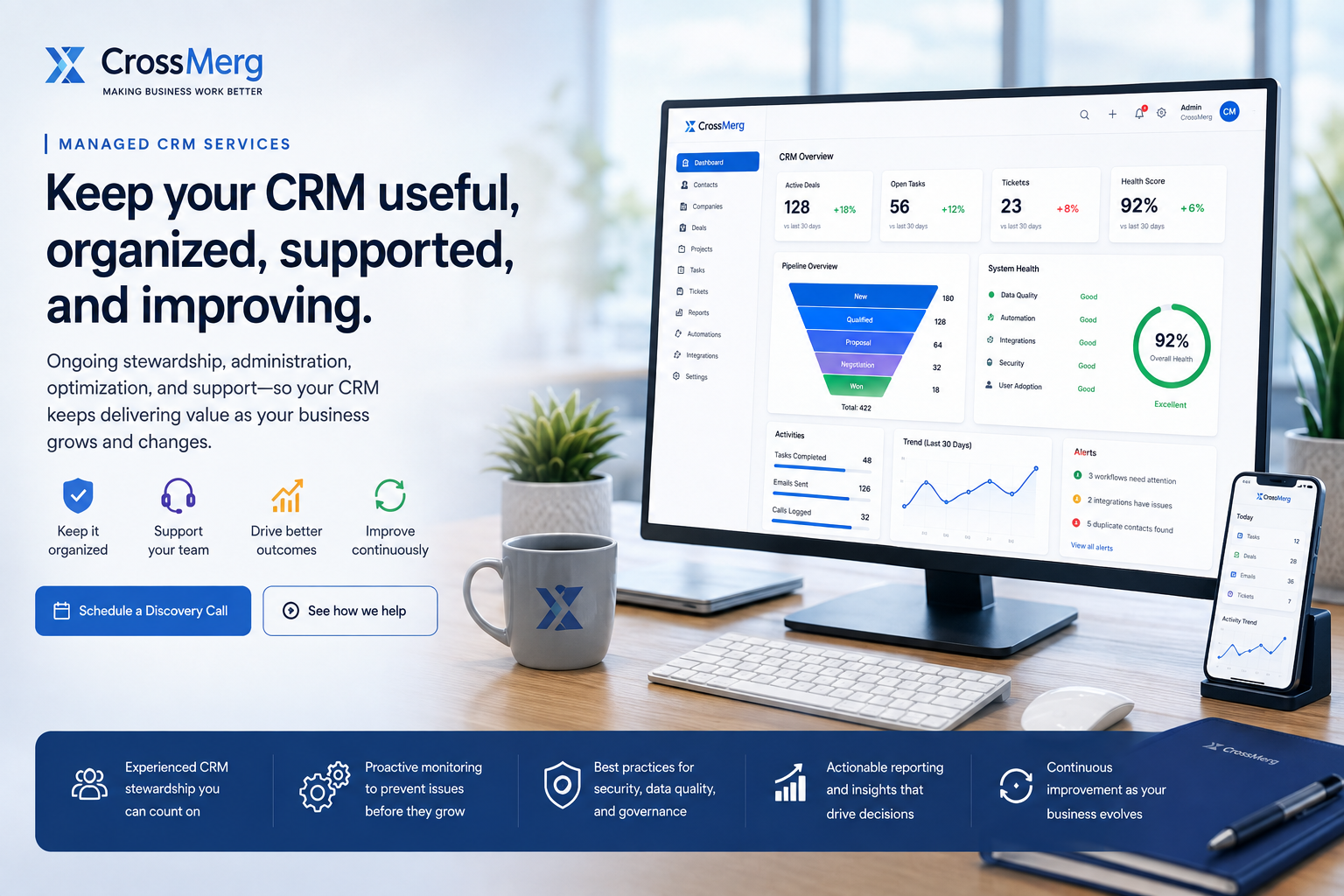
Ongoing CRM stewardship for businesses that need the system managed without adding a full-time internal administrator.
CrossMerg handles the ongoing administration, configuration, data quality, reporting support, user assistance, and continuous refinement that keep your CRM aligned with the way your business actually works.
What happens after go-live?
Implementation creates the starting structure. After that, new people, new services, new reporting questions, customer exceptions, and day-to-day operating decisions begin changing what the CRM needs to support. Without clear ownership, reasonable requests can slowly turn into clutter, workarounds, and inconsistent processes.
Launch
Fields, workflows, permissions, reports, and user roles are aligned to the agreed implementation.
Change
New staff, services, exceptions, customer needs, and management questions create legitimate new requirements.
Drift
Small fixes, manual steps, duplicate fields, one-off reports, and informal processes start filling the gaps.
Ownership
Ongoing stewardship keeps the CRM aligned before those reasonable changes become long-term complexity.
New services, new staff, changing customer expectations, and new operating requirements create CRM changes that were not part of the original implementation.
Fields, views, permissions, reports, workflows, and user requests collect over time when nobody has clear responsibility for keeping the environment organized.
Questions, configuration requests, reporting needs, and process issues require someone who understands both the system and the business context behind the request.
Your CRM needs an owner
Most CRM environments do not become difficult because of one major decision. They become difficult through dozens of reasonable requests made over time without one person looking after the whole system. Managed ownership changes that operating pattern.
Without clear ownership
Reactive CRM upkeepWith ongoing stewardship
Managed CRM stewardshipWhat clear ownership changes
The practical value is not simply having someone available to make changes. It is having someone responsible for how those changes affect the system as a whole.
Requests, fixes, reporting needs, and improvement ideas have a clear review path instead of being handled differently by each person.
Configuration decisions are made with the broader workflow, data model, reporting, permissions, and user experience in mind.
Questions and blockers have an owner, reducing the temptation to build side spreadsheets, manual workarounds, or unofficial processes.
Instead of waiting for the CRM to become painful, recurring issues and opportunities become part of an ongoing improvement backlog.
CrossMerg becomes the practical CRM steward. Your team still owns the business decisions. We take responsibility for translating those decisions into controlled CRM administration, support, governance, reporting, and ongoing improvement.
The managed CRM service model
Managed CRM Services is not a queue of unrelated requests. Each change is reviewed in context, implemented carefully, supported in real use, measured against what happens next, and folded back into the next improvement decision.
Understand
Understand what changed, what is creating friction, and what deserves attention first.
Operate
Make controlled CRM changes and help users work effectively inside the intended process.
Improve
Use real usage, reporting, recurring issues, and business changes to guide the next improvement.
Ongoing stewardship
Business change becomes controlled CRM change. Then the cycle begins again.Look at usage, requests, data quality, reporting needs, and current friction.
Separate useful improvements from low-value changes and decide what should happen first.
Make controlled changes to fields, permissions, workflows, views, dashboards, and settings.
Help users understand the system, resolve blockers, and reinforce the intended process.
Review adoption, reporting, exceptions, recurring requests, and operational results.
Refine the areas where real usage shows a simpler, clearer, or more dependable approach.
Keep the CRM aligned as the business, team, and customer journey continue to change.
Requests enter with context
Why does this need to change?Changes are made deliberately
What else will this affect?Real usage informs the next step
What should improve next?What CrossMerg manages
Managed CRM Services brings recurring CRM responsibility into one operating model. CrossMerg helps run the environment, protect its structure, and improve it over time so administration does not become disconnected from governance, support, reporting, or the way the business is changing.
Run
Administration, configuration, user support, and reporting needs that keep the system usable and responsive to the business.
Administration
Ongoing changes to fields, pipelines, statuses, permissions, views, settings, forms, and other CRM configuration as business needs evolve.
Visibility
Maintain and refine reports, dashboards, filters, management views, and the underlying data structure needed to make reporting useful.
Adoption
Help team members understand how to use the CRM, resolve recurring questions, reinforce the intended workflow, and identify where additional guidance is needed.
Protect
Governance, data quality, standards, permissions, and structure that reduce drift and protect long-term CRM reliability.
Governance
Practical standards for records, fields, naming, ownership, duplicates, required information, and data cleanup priorities.
Improve
Workflow refinement, improvement planning, and ongoing optimization that turn recurring friction into deliberate progress.
Optimization
Review how work actually moves through the CRM, identify unnecessary steps, and improve the places where users are relying on manual workarounds.
Improvement
Maintain a practical improvement backlog and revisit opportunities as priorities, workflows, integrations, reporting needs, and staffing change.
Clear responsibility
Managed CRM Services works best when responsibility is explicit. CrossMerg takes ownership of the system work and ongoing stewardship. Your team retains the decisions, context, approvals, and accountability that belong inside the business.
CrossMerg owns
We take responsibility for keeping the environment organized, supported, governed, and improving within the agreed service scope.
Shared decision layer
Context + review + approval + execution + feedback Where business priorities become controlled CRM changes.Your team owns
Your leadership and staff remain responsible for priorities, policies, approvals, operational expectations, and the context only the business can provide.
How the partnership works
The relationship works because neither side is operating in isolation. Business knowledge informs CRM decisions, and CRM knowledge helps the business understand the impact of those decisions before they become permanent system changes.
Your team explains what changed, what outcome is needed, and what constraints or priorities matter.
CrossMerg evaluates the request against CRM structure, reporting, workflow, permissions, and long-term maintainability.
Material process, policy, or ownership decisions remain with your business before controlled CRM changes are made.
CrossMerg implements approved CRM changes, keeps the environment organized, and supports users through the change.
Real usage and business feedback determine whether the change worked and what should be improved next.
Practical business outcomes
The value is not the number of fields changed, reports edited, or support requests closed. The value is the operating environment those actions create: clearer ownership, cleaner information, better user confidence, stronger visibility, and fewer unresolved CRM problems accumulating over time.
Cleaner
Fields, records, views, permissions, and processes stay organized instead of collecting years of unchecked clutter.
Faster
New business requirements have a clear review path instead of waiting for someone internally to figure out the CRM.
Stronger
Staff know where to go when they have questions and are less likely to create disconnected workarounds.
Better
Reports and dashboards remain tied to the information leaders actually use to understand performance and workload.
What changes operationally
The difference shows up in how the business handles change, how users work inside the CRM, how reliable the information remains, and how confidently managers can use that information.
CRM requests move through a consistent review and prioritization path instead of being handled ad hoc.
Questions and friction are addressed inside the CRM process before side systems and manual habits become permanent.
Fields, records, ownership, permissions, and standards stay more consistent as the environment evolves.
Reports and dashboards continue adapting to the questions leaders actually need the CRM to answer.
The practical result
Instead of periodically needing another rescue project, the environment receives steady attention, controlled changes, user support, and improvement before small issues become structural problems.
Managed CRM Services questions
Managed CRM works best when the service model matches the environment you already have, the amount of ongoing change it requires, and the responsibilities your team needs someone to own consistently.
Service decision guide
Managed CRM Services is strongest when the CRM foundation is usable and the ongoing need is ownership, administration, support, governance, reporting, or continuous improvement.
Ongoing ownership
Growing environment
Foundation first
A new or substantially rebuilt environment may belong in CRM Implementation first, then transition into managed stewardship after launch.
Review CRM ImplementationDedicated project first
Choose the service by the responsibility that needs an owner. If the CRM foundation is sound but ongoing administration, support, governance, reporting, and improvement keep falling between people, Managed CRM Services is usually the right conversation.
Frequently asked questions
The right managed service relationship depends on the CRM you already have, how much ongoing change it requires, who currently owns administration, and where your team is losing time or consistency. These answers explain the CrossMerg approach.
The decision is about ownership. Start by identifying the CRM responsibilities that repeatedly need attention but do not have a dependable owner today.
No. CRM Implementation establishes and launches the CRM foundation. Managed CRM Services is the ongoing operating relationship that keeps the environment administered, supported, governed, measured, and improved after launch.
Potentially. We first review the current environment, configuration, data condition, workflows, reporting, user needs, and technical constraints. From there we can define what can be managed safely and what should be stabilized first.
For many small and growing teams, that is the purpose of the service. CrossMerg can provide ongoing hands-on CRM administration and improvement without requiring the business to maintain a dedicated full-time administrator. The exact division of responsibility is agreed before work begins.
Yes, when user support is included in the agreed service scope. We can help with practical CRM questions, usage guidance, recurring blockers, and identifying whether a request requires training, configuration, or a broader process decision.
Requests are reviewed in context rather than changed immediately. We consider the business reason, affected users, reporting impact, dependencies, and whether the request creates unnecessary complexity. Approved changes are then prioritized and implemented in a controlled way.
Yes. Reporting support can include refining dashboards, filters, management views, recurring reports, and the CRM data structure those reports depend on. Reporting needs are reviewed as the business changes.
Yes, within the agreed managed scope. Smaller refinements can be handled as ongoing optimization. Larger automation or integration projects may be separated into their own clearly scoped project when the work requires deeper design, testing, or external-system changes.
CrossMerg maintains a practical view of recurring user questions, data-quality issues, reporting gaps, workflow friction, and business changes. Those signals help create an improvement backlog so the highest-value work can be addressed first.
A practical first conversation
We can look at how the CRM is being managed today, where requests are getting stuck, what users keep working around, and which responsibilities need a clearer owner.
What we can review together
Review the current CRM environment and the changes your team keeps requesting.
Identify where administration, support, governance, reporting, or adoption lacks clear ownership.
Decide whether ongoing Managed CRM Services—or a focused project first—is the better next step.
Define the most useful next step before adding more CRM complexity.
Start with the CRM you have and decide what deserves ongoing ownership first.
Bring us the CRM you have today. We will help identify what needs ongoing ownership, what should be cleaned up or improved first, and whether a managed service relationship makes sense for your team.
Why businesses trust CrossMerg
We help teams improve the client experience without adding unnecessary complexity, forcing a large migration, or losing sight of how the business actually works.
Practical value
Founder perspective
How we work
Client-first language
We translate internal workflow into simple client-facing steps that reduce friction.
Lightweight rollout
Start with one feature before rolling out deeper portal options.
Works with your reality
We respect your team size, tools, and capacity — no forced big-bang migrations.