Small issues become recurring friction
Minor configuration problems, broken handoffs, user questions, and one-off fixes accumulate when there is no dependable support path.
Support • Maintenance • Reliability • Improvement
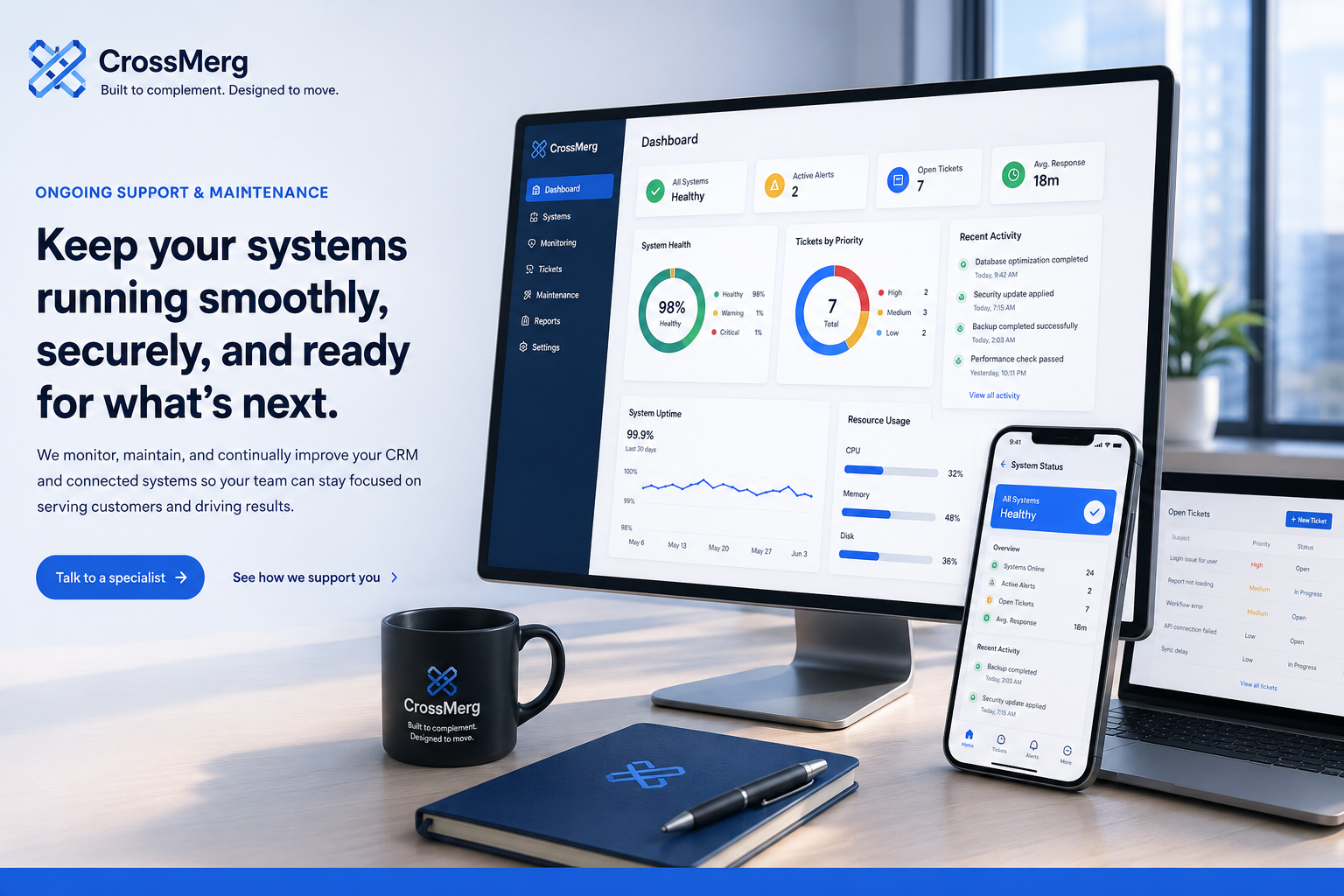
CrossMerg provides an ongoing support layer for the CRM, websites, workflows, integrations, and connected business systems we help manage—so small issues are addressed, important changes are controlled, and your operating environment keeps improving instead of slowly drifting.
After launch, the environment keeps changing
The systems behind daily work continue changing after implementation. Ongoing support gives those changes, questions, fixes, maintenance needs, and improvement opportunities a controlled place to go.
Minor configuration problems, broken handoffs, user questions, and one-off fixes accumulate when there is no dependable support path.
New staff, new services, new customer expectations, and new operating requirements create legitimate changes after the original project ends.
Updates, cleanup, testing, documentation, and routine technical work are easy to postpone when the immediate business day is already full.
Issues often become visible only when a user is blocked, a workflow fails, a customer is affected, or an important deadline is close.
Internal staff, vendors, and managers may each know part of the environment without anyone owning the complete support path.
Teams notice better ways to work, but improvement ideas are rarely prioritized alongside routine support and maintenance needs.
Support as an operating layer
Ongoing Support & Maintenance works best when day-to-day help, routine upkeep, and useful improvements stay connected instead of becoming separate queues with separate owners.
Support
Give users and managers a clear path for questions, troubleshooting, configuration problems, and operating blockers.
Help staff understand the intended process and work through system questions or blockers.
Trace symptoms back to configuration, workflow, integration, data, or usage causes.
Correct issues safely and verify that the expected business process is restored.
Maintain
Handle the routine technical and administrative work that protects system quality over time.
Keep fields, views, permissions, settings, and supporting structures organized.
Check important changes, workflows, forms, and connected processes before they create surprises.
Keep practical notes around important changes, operating decisions, and recurring support patterns.
Improve
Use support patterns and business changes to identify improvements that reduce future support demand.
Capture recurring requests and ideas instead of losing them between urgent tasks.
Focus first on improvements with the clearest operational value or risk reduction.
Revisit workflows, reporting, integrations, and user experience as real usage evolves.
One connected support layer
A recurring user question may reveal a workflow problem. A maintenance task may expose technical debt. A repeated fix may be better solved with a controlled improvement. The value comes from treating those signals as one operating picture instead of three disconnected queues.
A controlled support lifecycle
The goal is not simply to close tickets. Each request should be understood in context, resolved appropriately, validated, and used to improve the environment when the pattern points to a larger opportunity.
Capture a support request, maintenance need, recurring issue, or improvement opportunity.
A clearly described need with enough context to begin.
Understand the cause, affected process, urgency, dependencies, and business impact.
A practical understanding of cause, impact, and scope.
Decide what needs immediate attention, planned maintenance, or a larger project scope.
The right path: support, maintenance, improvement, or project work.
Make the appropriate configuration, repair, support, cleanup, or controlled change.
A controlled change tied to the actual cause.
Confirm the result works as intended and has not created avoidable downstream problems.
A verified result with the intended process restored.
Use what was learned to reduce recurrence, simplify the process, or improve the environment.
A healthier system with fewer repeat issues over time.
Immediate objective
Restore the workLong-term objective
Improve the environmentSupport creates operating intelligence
When the same issue, question, workaround, or maintenance need appears repeatedly, it becomes evidence for where the system or process should improve.
Clear responsibility
A dependable support relationship needs explicit boundaries. Technical ownership belongs with CrossMerg inside the agreed scope; operating priorities, approvals, and business accountability stay with your team.
CrossMerg owns
We take responsibility for the technical work inside the agreed support boundary.
We share
The strongest support relationship keeps technical reality and business priorities connected.
Your team owns
Your team remains accountable for the business rules, priorities, approvals, and internal adoption.
Simple handoff rule
When a support issue crosses that boundary, we surface the decision clearly instead of making assumptions on either side.
The business result
A well-run support layer protects continuity while making it easier to improve the environment deliberately instead of waiting for problems to force the next change.
Issues linger, workarounds spread, and users lose time figuring out who owns the problem.
Requests have a known path, priority, owner, and verification step.
Maintenance is deferred until something visibly breaks or becomes difficult to change.
Routine upkeep, validation, cleanup, and controlled changes happen as part of ongoing care.
Each issue starts with rediscovery: what changed, who owns it, and how the system was configured.
System context, recurring patterns, and technical ownership stay closer to the support work.
Recurring friction is fixed repeatedly without changing the underlying process.
Patterns are captured and used to identify workflow, reporting, integration, or usability improvements.
Internal staff, vendors, and managers each know part of the environment but not the complete support path.
Technical responsibilities, business decisions, and shared priorities are defined explicitly.
Every request is treated the same even when some are actually larger projects.
Support, maintenance, improvement, and project work are separated based on real scope and impact.
What changes in practice
The goal is not to create more process around support. It is to reduce rediscovery, ambiguity, deferred maintenance, repeated fixes, and avoidable disruption.
Questions before you start
Ongoing Support & Maintenance is designed for dependable support and upkeep of an existing environment. This guide helps separate that need from adjacent managed services and larger project work.
Service decision guide
You need dependable help keeping existing systems supported, maintained, tested, and improving.
You need broader ongoing CRM stewardship, administration, governance, reporting, and user support.
The primary need is a significant new automation or workflow redesign rather than ongoing maintenance.
The main requirement is a substantial new connection between systems, data flows, or external services.
Simple decision rule
If the request substantially changes the operating model, introduces a new system connection, or requires a major redesign, treat it as project work first and return it to ongoing support afterward.
The exact scope is defined with you, but support can include the CRM environment, websites, forms, workflows, integrations, reporting, client-facing experiences, and other connected systems CrossMerg is responsible for supporting or maintaining.
No. Reactive issue resolution is only one part of the service. The stronger model includes routine maintenance, controlled changes, validation, recurring-issue review, and practical improvement work.
We look at urgency, business impact, affected users or customers, dependencies, risk, and whether the request is a support item, planned maintenance task, improvement, or larger project.
Potentially. We first need enough visibility into the current environment to understand its configuration, condition, dependencies, access, and any existing technical debt before accepting responsibility for ongoing support.
We separate larger work from routine support rather than forcing it through the wrong service model. A substantial redesign, implementation, integration, or automation project can be scoped independently and then returned to ongoing support after completion.
Yes, when they fit the agreed scope. Recurring issues and user friction often reveal opportunities to simplify a workflow, improve reporting, clean up configuration, or reduce future support demand.
Useful boundary
If the work is recurring care, support, maintenance, and contained improvement, it belongs here. If it substantially changes the system, it may deserve its own project scope first.Put a dependable support layer around the systems you already rely on
We’ll review what your team is supporting today, where issues keep recurring, which systems need routine care, and whether an ongoing support relationship would reduce operational friction without turning every need into a new project.
Good starting point
Start with the systems, recurring issues, maintenance backlog, and ownership gaps. We can help separate what belongs in ongoing support from what should stay internal or become a defined project.
Why businesses trust CrossMerg
We help teams improve the client experience without adding unnecessary complexity, forcing a large migration, or losing sight of how the business actually works.
Practical value
Founder perspective
How we work
Client-first language
We translate internal workflow into simple client-facing steps that reduce friction.
Lightweight rollout
Start with one feature before rolling out deeper portal options.
Works with your reality
We respect your team size, tools, and capacity — no forced big-bang migrations.