Conversations live in separate inboxes
Important context stays inside individual email accounts, messages, calls, and personal notes instead of following the customer record.
History • Communication • Ownership • Retention • Visibility
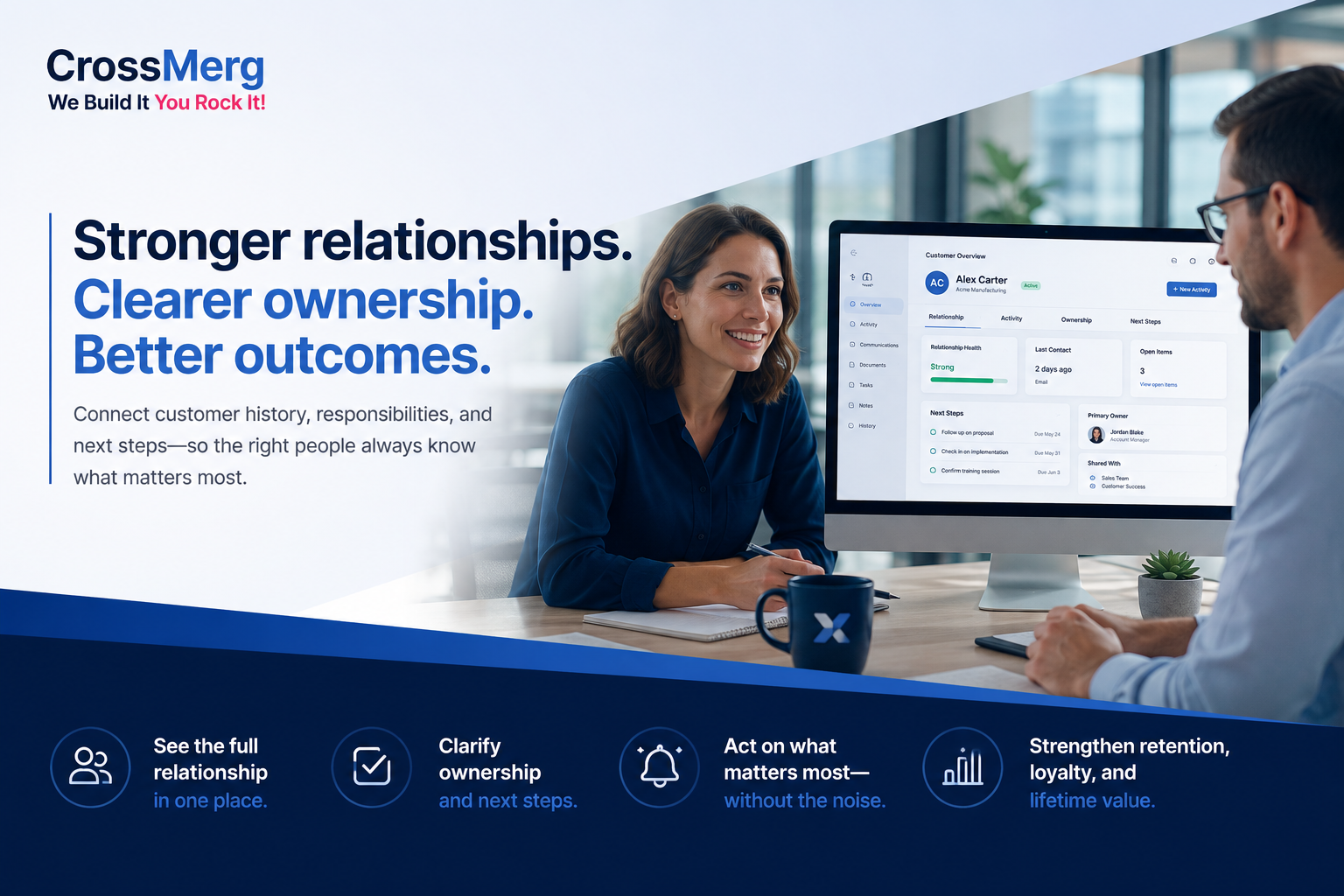
CrossMerg helps your team understand who the customer is, what has happened, what is happening now, who owns the relationship, and what should happen next.
When customer information becomes fragmented
Customer relationship management is not simply storing contact information. It is preserving enough shared context for the business to understand what has happened, what is happening now, and what deserves attention next.
Important context stays inside individual email accounts, messages, calls, and personal notes instead of following the customer record.
Sales, onboarding, service, billing, support, and follow-up activity are stored in different places or recorded inconsistently.
Several people may interact with the same customer, but responsibility for the next action is not always obvious.
Renewals, callbacks, check-ins, promises, and service milestones are remembered manually instead of being visible as structured next steps.
A support issue, delayed project, complaint, or billing question may be visible, but the wider relationship history is not.
Signals such as inactivity, stalled work, missed commitments, support patterns, or renewal risk are difficult to recognize early.
Build a complete customer view
The strongest customer record connects identity, conversations, commercial history, active work, promises, and future opportunities without requiring the team to search through unrelated systems.
Contact details, company information, preferences, roles, and relationship context organized around one dependable record.
Useful communication context, notes, meetings, and important exchanges connected to the relationship.
Quotes, invoices, products, services, agreements, and commercial activity visible alongside the wider relationship.
Projects, tasks, requests, appointments, deliverables, and current service activity easier to understand in context.
Assigned follow-up, due dates, commitments, reminders, and ownership tied directly to the customer.
Expansion conversations, renewals, additional services, referrals, and future value kept visible without turning every interaction into a sales pitch.
Customer relationship lifecycle
Customers do not always move in a straight line. This lifecycle shows the kinds of relationship states CrossMerg can help keep understandable as people buy, onboard, receive service, grow, renew, and advocate.
Early interest, qualification, source, conversations, and expectations begin forming the relationship record.
The relationship becomes active with clear ownership, approved work, commercial history, and agreed next steps.
Setup, introductions, requirements, milestones, documents, and initial commitments stay connected to the customer.
Ongoing work, communication, requests, tasks, service activity, and decisions remain visible to the right people.
Questions and issues are handled with the benefit of the wider account history instead of as isolated tickets.
New needs, expansion opportunities, referrals, and additional value can be recognized when the timing is appropriate.
Renewal timing, relationship health, open concerns, outcomes, and next-term decisions are visible before deadlines arrive.
Strong relationships can become reviews, referrals, testimonials, repeat business, and long-term customer loyalty.
Lifecycle principle
CrossMerg keeps the customer record connected even when the real-world relationship does not follow a perfectly linear process.
Communication and interaction history
A useful relationship timeline does not need to record every trivial detail. It should preserve the conversations, decisions, commitments, milestones, and documents that help the business understand the customer.
Shared relationship timeline
Keep important communication attached to the customer so the team can see what was discussed without reconstructing the story.
Record meaningful conversations, decisions, questions, objections, and commitments where the next person can find them.
Capture useful internal context separately from customer-facing communication while still preserving the relationship timeline.
Connect meetings, scheduled work, reviews, renewals, and important dates to the customer lifecycle.
Keep relevant proposals, agreements, approvals, files, and supporting materials close to the relationship record.
See how the relationship moved from one stage to another and what events or decisions influenced the change.
Continuity matters: the useful history stays with the customer record even when the employee, department, or current work changes.
Ownership, follow-up and accountability
Good relationship management turns customer promises into clear ownership, visible next actions, useful reminders, and contextual handoffs.
From promise to accountable next step
Make the primary owner clear while still allowing other teams to contribute to the customer experience.
Turn promises and follow-up into visible tasks, dates, reminders, or milestones instead of relying on memory.
Notify the right people when a customer reaches a meaningful stage, needs attention, or has a time-sensitive next step.
When ownership changes, the receiving person can understand the history, current state, open items, and expectations.
Use aging, inactivity, overdue tasks, or unchanged stages to identify relationships that may need intervention.
Operational result: the team can see who owns the relationship, what was promised, what happens next, and where attention is overdue.
Opportunities, renewals and retention
Growth and retention work best when they are based on real customer context. CrossMerg helps surface the right moments to review, reconnect, expand, renew, or ask for advocacy.
Relationship signals
Track renewal windows, review dates, open concerns, commercial history, and customer sentiment before the decision point arrives.
Recognize when an existing customer has a new need, additional location, larger team, or adjacent problem CrossMerg can help solve.
Use lifecycle milestones and relationship signals to create useful conversations before the customer has to ask for attention.
Identify strong relationships that may be appropriate for a review, testimonial, case study, referral, or reference request.
Surface dormant or inactive relationships and decide intentionally whether to reconnect, archive, or change the engagement strategy.
Bring together open issues, inactivity, missed commitments, declining engagement, or renewal timing so risk is easier to see early.
Better timing, not more outreach: relationship history helps the team decide when a renewal, expansion, check-in, advocacy, re-engagement, or retention conversation is actually appropriate.
Customer service and relationship health
Support history, active work, unresolved concerns, ownership, communication, and renewal timing can provide the context needed to protect a good customer relationship.
Relationship health view
Visible
Support, billing, project, or service concerns are easier to understand alongside the rest of the relationship.
Clear
Staff can see who is responsible, what has been promised, and which action should happen next.
Earlier
Inactivity, stalled work, unresolved concerns, and upcoming renewals can be surfaced before they become surprises.
Better
The customer receives a more connected experience when each interaction begins with useful history and context.
Early-warning principle
Open issues, inactivity, overdue actions, service patterns, ownership gaps, and renewal timing become more useful when they can be reviewed together.
Customer intelligence and visibility
The goal is not to collect data for its own sake. The goal is to make useful customer patterns easier to see so leaders and teams can decide where attention is needed.
Customer intelligence view
See how many customers are onboarding, active, waiting, at risk, approaching renewal, expanding, or inactive.
Review overdue actions, aging relationships, stalled stages, and customers waiting for a response.
Understand when communication is active, quiet, increasing, or tied to recurring questions and service needs.
Connect relationship activity with proposals, invoices, services, renewals, and future opportunities where appropriate.
Identify recurring support needs, open issues, response patterns, and operational friction that can affect retention.
Surface strong relationships, repeat work, referrals, expansion conversations, and other indicators of future value.
Relationship management result
Practical business outcomes
Important relationship context follows the customer record instead of depending on one person remembering the history.
Employees spend less time searching across systems before answering a question, making a decision, or taking the next action.
Sales, service, support, operations, and leadership can work from a more connected understanding of the relationship.
Renewals and retention conversations can begin with visible history, open issues, outcomes, and relationship signals.
New needs and expansion opportunities are easier to recognize when the full relationship is visible in one place.
Leaders can review the health and movement of customer relationships without reconstructing the story from multiple tools.
Decision-support principle: the goal is not more customer data. It is enough connected context to help people make better decisions, prioritize attention, and act with confidence.
Relationship management questions
Customer relationship management questions
The right relationship model depends on your current process, teams, customer lifecycle, systems, and available data. These answers explain the CrossMerg approach.
CRM Implementation focuses on designing, configuring, migrating, and launching the CRM foundation. Customer Relationship Management focuses on how that system supports the ongoing relationship after the foundation exists—history, communication, ownership, follow-up, service activity, retention, opportunities, and visibility.
No. The lifecycle is a visibility framework, not a rigid sequence. Different customers may skip stages, return to earlier stages, have multiple workstreams, or remain active for years. The goal is to keep the current relationship state understandable.
Yes, within the limits of the available source data. CrossMerg can review approved records, exports, spreadsheets, notes, and supported systems to determine what history is useful to migrate or reorganize. Missing or unreliable history is identified rather than invented.
Yes. A shared customer record can support sales, onboarding, service, projects, billing, support, and management while roles and permissions control who can see or change sensitive information.
Yes. Reminders, tasks, ownership rules, due dates, alerts, and workflow automation can be used where the business has a clear rule for what should happen and when.
Potentially. Useful health indicators depend on the information your business can reliably capture, such as activity, open issues, overdue actions, project status, communication patterns, renewal timing, or other business-specific signals.
Not necessarily. CrossMerg can centralize some customer-service activity and may connect with other systems where supported and useful. The right approach depends on your existing tools, requirements, integrations, and workflow.
Start with the relationship: the useful question is not simply which CRM has the most features, but which customer information, responsibilities, and next steps your team needs to keep connected.
Connect the customer relationship
We’ll review where customer history, communication, ownership, service activity, follow-up, and retention visibility are currently disconnected and recommend a practical way to bring the relationship together.
Why businesses trust CrossMerg
We help teams improve the client experience without adding unnecessary complexity, forcing a large migration, or losing sight of how the business actually works.
Practical value
Founder perspective
How we work
Client-first language
We translate internal workflow into simple client-facing steps that reduce friction.
Lightweight rollout
Start with one feature before rolling out deeper portal options.
Works with your reality
We respect your team size, tools, and capacity — no forced big-bang migrations.