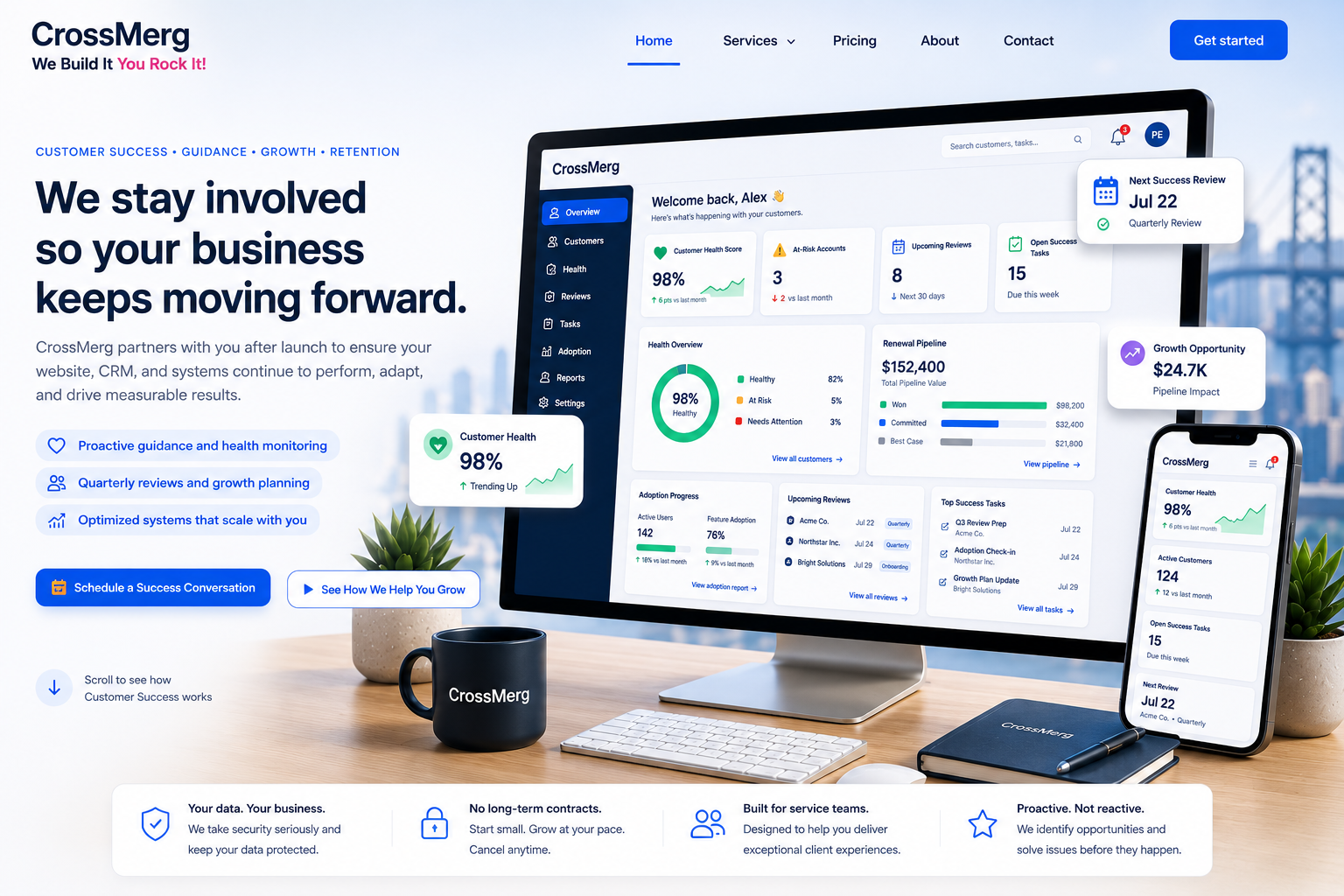
The project ends at launch
The website or CRM goes live, but the business is left without an accountable partner to guide adoption, answer questions, or shape the next improvement.
Guidance • Support • Training • Optimization • Growth
We stay involved after implementation—learning your business, supporting your people, improving daily workflows, and helping the system keep creating value as the business evolves.
Why momentum fades after implementation
Technology does not stay aligned on its own. Teams change, questions appear, processes evolve, and small points of friction can quietly reduce adoption and results.
The website or CRM goes live, but the business is left without an accountable partner to guide adoption, answer questions, or shape the next improvement.
Without continued guidance, staff fall back to familiar habits and valuable features remain unused or misunderstood.
Questions, permissions, process gaps, and minor friction accumulate because nobody owns the full customer experience after implementation.
Services, staffing, customer expectations, and internal processes evolve, but the original setup remains frozen in time.
The business has activity data, feedback, and recurring questions, but no regular process turns those signals into useful decisions.
Problems receive attention only after they interrupt operations instead of being prevented through monitoring, training, and periodic review.
What Customer Success should provide
Customer Success connects the technology to the people, processes, questions, and priorities that determine whether it produces lasting value.
We stay close enough to understand what is changing. The goal is not only to answer questions—it is to help your people feel supported, adopt better habits, and keep improving the way the business operates.
Customer Success should understand the company, team, services, priorities, and operating realities—not just the software configuration.
Business context • named priorities • continuity
Relationship activeQuestions and small blockers should be resolved before they become workarounds, lost adoption, or larger operational problems.
Responsive guidance • issue ownership • clear next steps
Fast responseStaff should receive practical explanations and reinforcement so the system becomes part of daily work instead of something only one person understands.
Training • adoption support • role-based guidance
Adoption growingThe relationship should produce useful improvements as the business grows, learns, changes processes, and identifies new opportunities.
Reviews • recommendations • continuous improvement
Review scheduledOne connected success lifecycle
Customer Success is a continuous operating relationship. Learning, training, support, review, and improvement stay connected rather than becoming isolated events.
We establish the relationship, confirm goals, clarify responsibilities, and make sure the team knows where to go for help.
We deepen our understanding of the business, team roles, workflows, customer experience, and priorities.
We help staff use the system confidently through practical training, answers, reinforcement, and role-specific guidance.
We resolve questions, investigate friction, coordinate fixes, and keep day-to-day operations moving.
We examine usage, recurring requests, business changes, results, and the next highest-value opportunities.
We introduce improvements, new capabilities, and process changes that help the system continue supporting the business.
Practical Customer Success services
CrossMerg combines business context, staff enablement, operational support, and continuous improvement into one accountable relationship.
A continuing relationship with people who understand your goals, setup, history, and operating environment.
Always connectedClear guidance for questions, unexpected behavior, permissions, process decisions, and day-to-day system use.
Questions ownedRole-based explanations, refreshers, and onboarding help as staff responsibilities or team members change.
Team enabledStructured conversations about what is working, what changed, where friction exists, and what should happen next.
Priorities clearPractical review of activity, adoption signals, recurring requests, customer paths, and important outcomes.
Signals visibleA clear, business-focused view of which improvements deserve attention now, later, or not at all.
Next step readyMonitoring, maintenance coordination, process checks, and early intervention before small problems spread.
Risk reducedRefinements that reduce repetitive work, clarify handoffs, improve consistency, and make the system easier to use.
Friction removedHelp evaluating and introducing new features, integrations, automations, pages, or operational tools.
Capability addedThe system can change with new services, staff, customer expectations, and business opportunities.
Value compoundingBefore and after Customer Success
The difference is sustained adoption, faster answers, clearer priorities, and a partner who keeps the system aligned with the business.
Before
After CrossMerg
Business outcomes
The exact outcomes depend on the business, but every Customer Success relationship aims to improve confidence, adoption, responsiveness, and long-term value.
Higher
Staff know how to use the system, where to get help, and how their work fits the larger process.
Faster
Questions and operational friction reach an accountable partner instead of turning into long-term workarounds.
Better
Useful capabilities become part of daily work because training, reinforcement, and process guidance continue.
More
The platform evolves through focused improvements that continue supporting the business as it changes.
Customer Success questions
The exact Customer Success rhythm can be shaped around the business, team, platform, and level of ongoing change.
Customer Success includes ongoing guidance, practical support, team training, adoption help, business reviews, workflow recommendations, and coordination of useful improvements after implementation.
Technical support focuses on fixing a specific problem. Customer Success also considers adoption, business goals, workflow quality, team confidence, future priorities, and whether the system is producing useful value over time.
Yes. We can help new team members understand the parts of the system relevant to their role and provide refreshers when responsibilities or processes change.
The appropriate rhythm depends on the business, plan, and amount of change. Reviews are designed to be practical and may occur regularly or around important milestones, priorities, or implementation phases.
Yes. We can identify opportunities, explain the business value and tradeoffs, prioritize the work, and help introduce the improvement without disrupting frozen or working processes.
Absolutely. CrossMerg provides context, recommendations, and implementation guidance. Your business remains in control of priorities, policies, staffing, customer experience, and final decisions.
Build a relationship that keeps creating value
Let’s talk about how your team uses its current systems, where support or adoption is slipping, and which ongoing improvements would create the clearest business value.
Why businesses trust CrossMerg
We help teams improve the client experience without adding unnecessary complexity, forcing a large migration, or losing sight of how the business actually works.
Practical value
Founder perspective
How we work
Client-first language
We translate internal workflow into simple client-facing steps that reduce friction.
Lightweight rollout
Start with one feature before rolling out deeper portal options.
Works with your reality
We respect your team size, tools, and capacity — no forced big-bang migrations.