Electrical Contractors

Leads • Estimates • Scheduling • Service Calls • Follow-Up • Reporting

Keep every electrical opportunity connected from the first call to the completed job.

CrossMerg helps electrical contractors organize inquiries, estimates, scheduling, customer communication, field handoffs, follow-up, and business visibility around one connected operating system—with CRM at the center.

CRM-centered Built around your electrical workflow Works with useful tools you already have
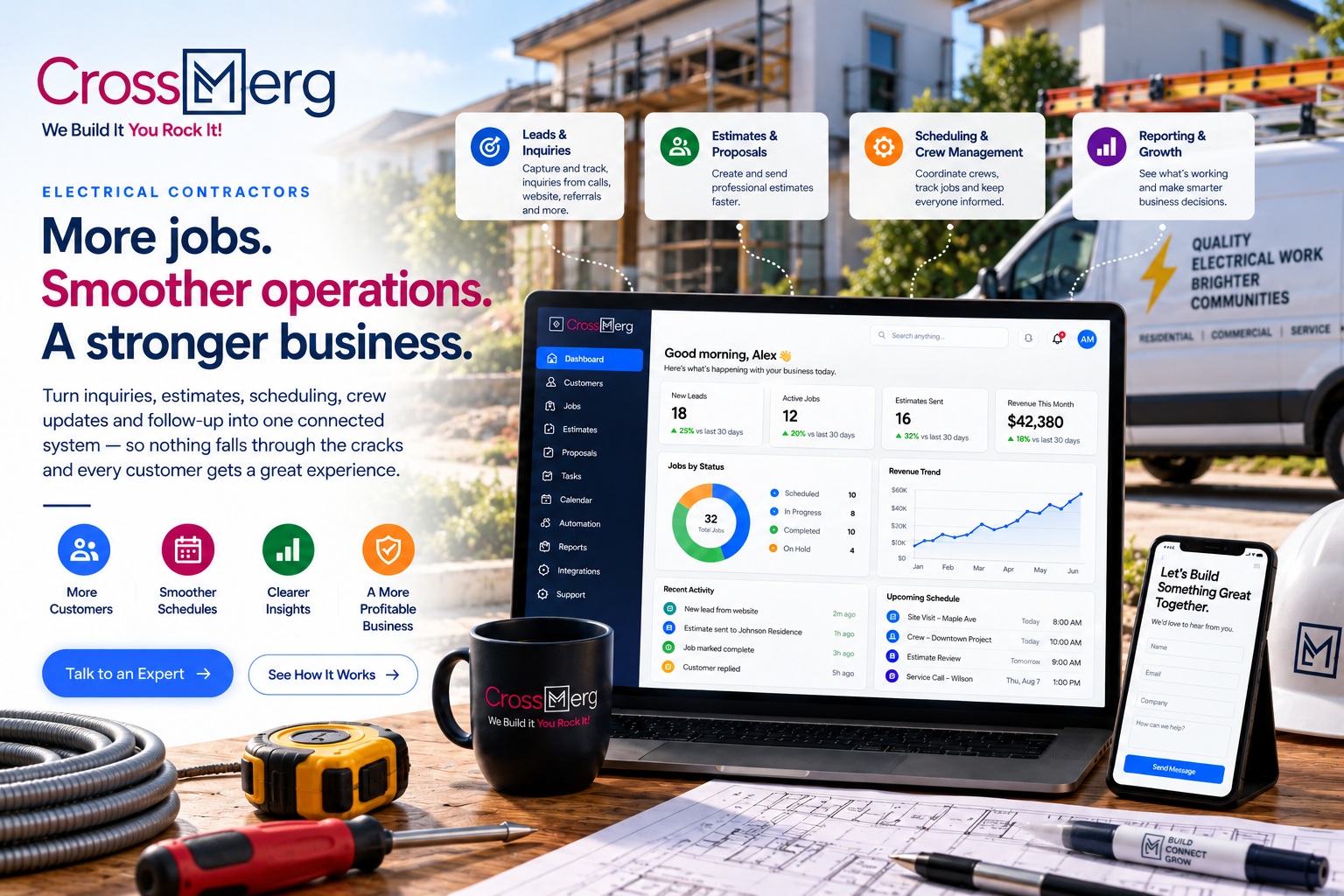
CrossMerg Electrical Contractors workspace with CRM dashboard, leads, estimates, scheduling, service calls, reporting, electrical tools, plans, and field-service business context

Where good work gets harder to manage

The problem usually is not electrical expertise. It is what happens between the handoffs.

Electrical contractors work across phones, properties, offices, service vehicles, job sites, estimates, schedules, customers, inspections, and active field work. The system has to keep the relationship connected while the work keeps moving.

A good electrical lead arrives while the team is already moving

Phone calls, website inquiries, referrals, emergency requests, and repeat-customer needs arrive while estimators, office staff, and electricians are already managing active work.

What that creates The first response and next follow-up can depend too much on memory.

The estimate becomes disconnected from the original conversation

Site notes, photos, panel or service details, scope, pricing, approvals, and follow-up can end up separated from the customer record that started the opportunity.

What that creates The customer and estimate stop telling one consistent story.

Scheduling and dispatch change faster than the office can relay it

Emergency work, technician availability, inspection windows, parts, permits, and job duration can shift the day quickly.

What that creates Customers and staff spend time chasing the latest status.

The field learns things the CRM never sees

Electricians uncover access issues, panel conditions, code concerns, added work, material needs, photos, or future opportunities that may never make it back into the customer record.

What that creates Useful job knowledge disappears after the visit.

Completed work does not always create the next touchpoint

Review requests, maintenance reminders, warranty follow-up, inspection needs, and future electrical upgrades are easy to postpone once the immediate job is finished.

What that creates Repeat business depends more on remembering than on a dependable process.

The owner has activity but not enough visibility

Inquiries, estimates, scheduled work, lost opportunities, follow-up, and revenue signals may require multiple systems or manual reports.

What that creates It becomes harder to see where work is getting stuck or what deserves attention.
Connected business-system capabilities

Put CRM at the center without pretending the CRM has to do everything.

The goal is one understandable customer and operating workflow, supported by the right tools around it.

First response

Lead intake & follow-up

Bring inquiries into a consistent CRM process with service need, source, urgency, ownership, status, notes, reminders, and clear next actions.

Sales workflow

Estimate pipeline

Track the movement from site visit or service evaluation to estimate sent, follow-up, approval, decline, or future opportunity without losing the customer history.

Operations

Scheduling & dispatch context

Connect the customer, scope, urgency, job notes, and appointment context so the office and field team can see what is planned and why it matters.

Customer experience

Customer communication

Use consistent appointment messages, estimate follow-up, status updates, reminders, and post-job communication where automation is useful.

Team handoff

Job & field handoffs

Keep notes, photos, panel or equipment details, changes, customer requests, and next-step information connected across office and field workflows.

Management visibility

Reporting & business signals

See lead flow, estimate movement, follow-up aging, scheduled work, customer history, and practical operating signals without building a reporting maze.

The operating principle

One connected process should be easier to understand than six disconnected tools.

CrossMerg focuses on relationship continuity, ownership, next actions, practical automation, and useful system connections—not adding software for its own sake.

The customer journey

A customer should not have to become a stranger every time the electrical work changes hands.

A connected workflow keeps the customer, opportunity, job context, communication, and next action understandable from first inquiry through future service.

  1. 01

    Inquiry

    Capture who reached out, what electrical need they have, urgency, source, and who owns the next response.

  2. 02

    Qualification

    Confirm service fit, location, urgency, property or system context, and the right next step.

  3. 03

    Estimate

    Keep the site visit, notes, photos, scope, pricing, proposal, and follow-up connected to the same opportunity.

  4. 04

    Approval

    Record the decision, agreed scope, customer expectations, permit or material needs, and handoff into scheduling.

  5. 05

    Scheduled

    Give office staff and electricians the customer and job context needed to prepare, dispatch, and communicate clearly.

  6. 06

    Electrical Work

    Bring field notes, photos, changes, material needs, customer requests, and useful job information back into the relationship record.

  7. 07

    Follow-Up

    Close the loop with completion steps, reviews, warranty or inspection follow-up, future upgrades, and additional opportunities.

The result: fewer invisible handoffs, clearer ownership, better customer context, and a much easier path for the next person to know what should happen.

Practical outcomes

Improve the parts of the business customers and staff actually feel.

The value is not another dashboard or another app. It is a more dependable day-to-day business process.

Faster, more consistent response

New electrical inquiries have an owner, status, history, and visible next action instead of relying on whoever remembers first.

Clearer estimate follow-up

The team can see which estimates need attention, which customers responded, and where opportunities are aging.

Better office-to-field continuity

Customer history and job context stay connected as work moves between office staff, estimators, electricians, and management.

A more dependable customer experience

Customers receive clearer communication around appointments, estimates, scheduling, job status, and follow-up.

More repeat-business opportunities

Completed work can feed reviews, warranty reminders, maintenance, upgrade opportunities, and future service conversations.

Better operating visibility

Owners and managers can see practical sales and service signals without stitching together the picture by hand every time.

Your business already works today

The first question is not “What can we replace?”

The better question is which parts of your current process should stay, which should connect, and which are causing enough friction to improve first.

Keep what is already useful

A working estimating, accounting, scheduling, dispatch, phone, payment, or field-service tool does not need to be replaced simply because CrossMerg becomes the CRM-centered system.

Connect where there is real value

When systems support integration, exports, APIs, webhooks, or dependable handoffs, CrossMerg can help reduce duplicate entry and disconnected customer information.

Use one clear source of relationship truth

The CRM should make it easier to understand the customer, opportunity, estimate, owner, next action, and important service context—even when specialist tools remain in place.

Send your information

Start with the basics.

Four quick details are enough to get the conversation started.

1
Send your information

Share only the basics we need.

2
We review it

A real person reads the details.

3
You get a clear next step

Direct follow-up from CrossMerg.

Common questions

Make the system fit the electrical business—not the other way around.

These are the questions that usually matter before a electrical contracting business changes how it manages leads, customers, estimates, and follow-up.

Decision guide

Four things to keep in view before changing the system.

Existing tools

Keep useful estimating, scheduling, accounting, dispatch, or field tools when they still serve the business well.

Automation

Automate repeatable communication and handoffs where it reduces chasing without making the process harder to manage.

Team fit

Design the workflow around the people actually answering calls, preparing estimates, scheduling work, and serving customers.

Visibility

Track the few business signals that help the owner or manager know where attention is needed.

01 Do we have to replace our estimating or scheduling software?

No. We begin with the tools and process you already use. If an existing estimating, scheduling, accounting, dispatch, phone, payment, or field system is doing its job, the better solution may be to keep it and improve how customer information and handoffs move around it.

02 Is this only for large electrical contractors?

No. The useful starting point is workflow complexity, not company size. A small owner-led electrical business can benefit from clearer lead and follow-up discipline, while a larger operation may need more structured ownership, dispatch context, permissions, reporting, and automation.

03 Can CrossMerg support both service calls and larger electrical projects?

Yes. The customer journey is similar, while the details can differ around urgency, estimating, permits, inspections, materials, crews, project duration, and scheduling. The system should reflect the way your electrical business actually works.

04 Can you automate estimate follow-up and customer reminders?

Yes, where automation supports the customer experience and the team can still understand what is happening. Follow-up can be based on stages, timing, status, service type, or other controlled business rules instead of sending generic messages blindly.

05 Can the CRM track repeat service, inspections, or future upgrade opportunities?

Yes. Customer history, property or system context, prior work, service categories, dates, reminders, and campaign eligibility can support future service, inspection follow-up, maintenance, reactivation, and upgrade opportunities.

06 What if our current process is mostly spreadsheets, texts, and notes?

That is a valid starting point. We can map what each tool is currently doing, identify the information that should become structured, and move the highest-value parts into a more dependable workflow without trying to rebuild everything at once.

07 Do you provide the CRM and also help manage it after launch?

Yes. CrossMerg is positioned as a managed business systems partner with CRM at the center. Depending on the scope, that can include implementation, configuration, workflow automation, integrations, reporting, training, support, and ongoing CRM management.

08 What happens after I submit the form on this page?

Your information enters the CrossMerg Electrical Contractors marketing workflow. We use what you provide to understand your current process and follow up with relevant information and a practical next step. You can unsubscribe from marketing communication through the normal unsubscribe controls.

Start with continuity: the best business system is not the one with the most features. It is the one that helps your team know who the customer is, what is happening, who owns the next step, and what should happen next.

A practical first conversation

Start with the electrical workflow you already have—not a generic software checklist.

We can look at how a new inquiry becomes an estimate, how approved work reaches the schedule and field team, what customers hear along the way, and where useful information or follow-up tends to disappear.

No forced software replacement No need to rebuild every process at once No obligation to buy before the workflow makes sense

What we can review together

01

Review how leads, estimates, scheduling or dispatch, customer communication, and completed electrical work are handled today.

02

Identify the handoffs, duplicate entry, missing information, and follow-up gaps creating the most friction.

03

Choose a practical first improvement and decide what should stay, connect, automate, or move into the CRM.

When you are ready, start with the workflow that is creating the most chasing, lost follow-up, or disconnected customer information today.

Electrical Contractors

Build a customer and service workflow your electrical team can actually keep using.

Bring us the process you have today. We will help identify where CRM, automation, integrations, and clearer ownership can reduce friction without turning your electrical business into a software project.

Why businesses trust CrossMerg

Practical systems. Clear ownership. Human support.

We help teams improve the client experience without adding unnecessary complexity, forcing a large migration, or losing sight of how the business actually works.

Practical value

Why teams choose CrossMerg

  • Fewer status calls because clients can see what’s happening.
  • Faster approvals because the next step is obvious.
  • Cleaner payments because invoices have context and history.
  • A more professional client experience without enterprise complexity.

Founder perspective

A note from the founder of CrossMerg

If you tell us what your clients struggle with today — approvals, payments, scheduling, status updates, or disconnected processes — we’ll recommend the smallest practical step that can make a meaningful difference.

We focus on improvements teams can actually adopt, not abstract features that look impressive in a demo but create more complexity in day-to-day operations.

Our starting point Find the smallest practical improvement that creates meaningful value.

How we work

How we build better client experiences

Client-first language

We translate internal workflow into simple client-facing steps that reduce friction.

Lightweight rollout

Start with one feature before rolling out deeper portal options.

Works with your reality

We respect your team size, tools, and capacity — no forced big-bang migrations.

Start small and expand later. No long-term contracts or surprise fees. Built and supported by a small, US-based team.