Tennis Instructors

Inquiries • Players • Scheduling • Lessons • Follow-Up • Retention

Keep every player relationship connected from first inquiry through lessons, programs, and long-term coaching.

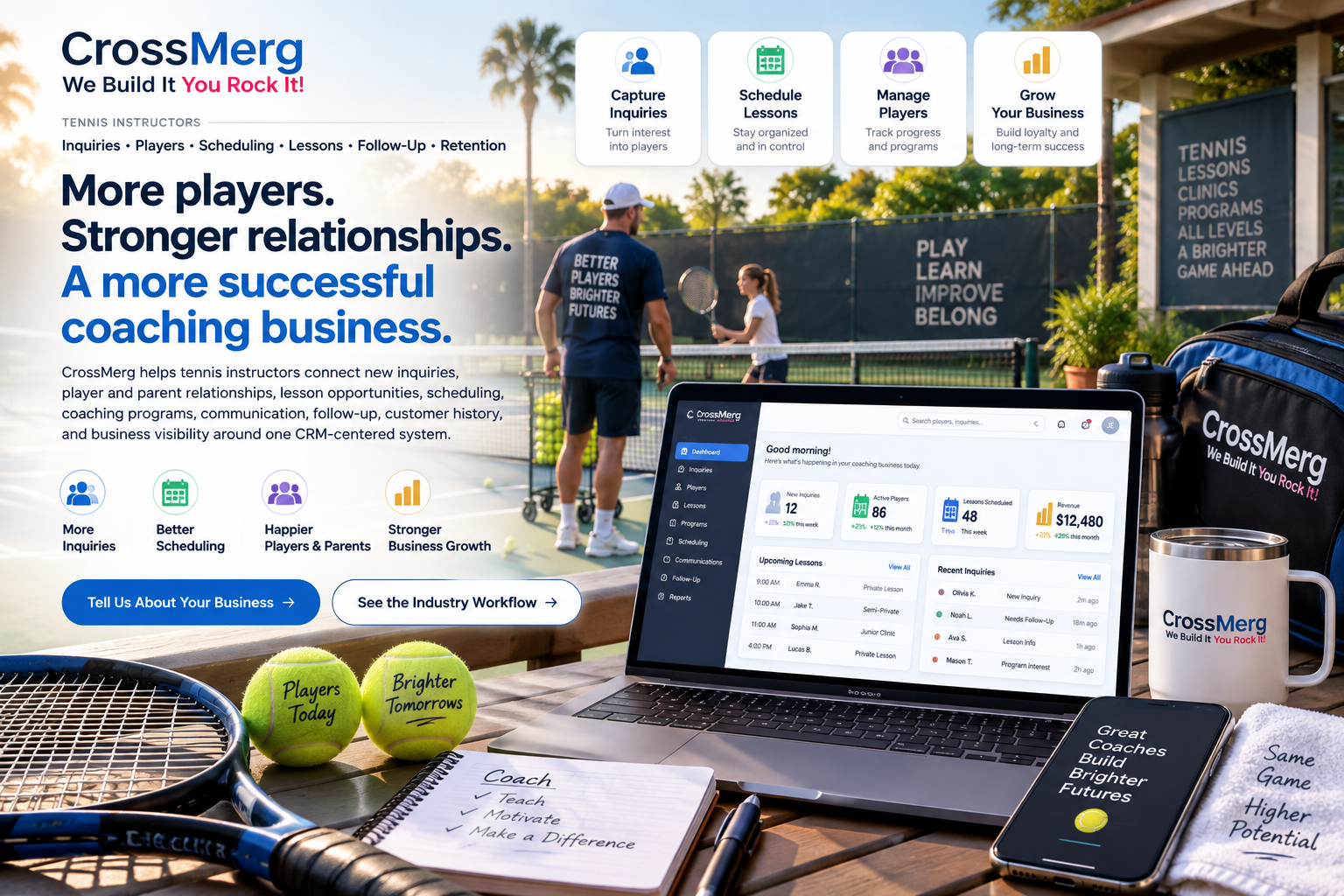
CrossMerg helps tennis instructors connect new inquiries, player and parent relationships, lesson opportunities, scheduling, coaching programs, communication, follow-up, customer history, and business visibility around one CRM-centered system.

CRM-centered Built around your coaching workflow Works with useful tools you already have
CrossMerg business systems workspace for tennis instructors with CRM, player inquiries, scheduling, follow-up, customer relationships, and reporting context

Where good work gets harder to manage

The problem usually is not coaching expertise. It is keeping the player relationship, inquiry, schedule, lesson or program, follow-up, and next action connected.

Tennis instruction moves across phone calls, texts, email, websites, referrals, player and parent conversations, courts, calendars, private lessons, group programs, cancellations, makeups, payments, and follow-up. The system has to keep the customer relationship connected while the coaching schedule keeps moving.

New player and parent inquiries arrive from several places

Website forms, referrals, clubs, facilities, social media, phone calls, camps, clinics, and word-of-mouth can all create opportunities while you are already on court.

What that creates Good prospects can wait too long when ownership and the next response are not visible.

Player goals, level, availability, and service fit can live in scattered conversations

Private lessons, group instruction, junior development, adult coaching, clinics, camps, match preparation, and ongoing programs each require useful context before scheduling.

What that creates The customer story gets rebuilt repeatedly when player information is split across texts, email, notes, and memory.

Scheduling changes constantly around courts, weather, players, and programs

Court availability, lesson length, travel, weather, cancellations, makeups, group sessions, and recurring programs can all affect the calendar.

What that creates Rescheduling and follow-up become administrative work instead of a controlled process.

Communication has to work for players, parents, and organizations

Confirmations, reminders, location details, program updates, follow-up, parent communication, and next-step conversations need to stay timely without becoming impersonal.

What that creates Small communication gaps can create missed lessons, confusion, and lost continuation opportunities.

Completed lesson packages do not automatically become long-term relationships

Players may be ready for another package, clinic, camp, seasonal program, match preparation, or future coaching but never receive a structured next touchpoint.

What that creates Retention and referral opportunities disappear after successful coaching has already created trust.

Busy calendars do not always show how the business is performing

Inquiry sources, conversion, active players, open opportunities, lesson demand, follow-up aging, program interest, and repeat activity may be difficult to see in one place.

What that creates Growth decisions depend on intuition when useful business signals are scattered.
Connected business-system capabilities

Put CRM at the center without pretending the CRM has to do everything.

The goal is one understandable inquiry, player relationship, scheduling, coaching, follow-up, and retention workflow supported by the right tools around it.

Inquiry ownership

Player & parent inquiry intake

Bring website inquiries, referrals, calls, club introductions, social leads, returning players, and program interest into a consistent CRM process with source, ownership, status, context, reminders, and next actions.

Opportunity pipeline

Lesson & program opportunity tracking

Track player level, goals, private or group interest, clinics, camps, trial lessons, package discussions, questions, decisions, and open follow-up from first conversation through enrollment.

Scheduling context

Scheduling & coaching coordination

Keep player, service, court, location, timing, recurring-session, cancellation, makeup, and program context connected so scheduling changes do not erase the relationship history.

Customer experience

Player & parent communication

Use consistent confirmations, reminders, program updates, follow-up, rebooking prompts, and appropriate automated communication while keeping personal coaching conversations personal.

Relationship history

Player & customer history

Keep inquiries, goals, services, lesson history, program participation, conversations, follow-up, preferences, and future opportunities connected to the customer relationship.

Management visibility

Reporting & business signals

See inquiry flow, opportunity movement, active-player activity, follow-up aging, program demand, retention, referral activity, and practical operating signals without building a reporting maze.

The operating principle

One connected process should be easier to understand than six disconnected tools.

CrossMerg focuses on relationship continuity, ownership, next actions, practical automation, and useful system connections—not adding software for its own sake.

The customer journey

A player relationship should not have to start over every time the conversation moves from inquiry to scheduling, coaching, follow-up, or the next program.

A connected workflow keeps the player or parent, goals, service interest, schedule, lesson or program history, communication, follow-up, and next action understandable from first inquiry through future coaching.

  1. 01

    Inquiry

    Capture who reached out, player or parent context, goals, level, preferred service, source, timing, location, and who owns the next response.

  2. 02

    Qualify

    Understand coaching goals, experience, availability, private or group fit, program interest, and the most appropriate next step.

  3. 03

    Schedule

    Connect the customer relationship to the trial lesson, consultation, recurring session, clinic, camp, or program schedule.

  4. 04

    Coach

    Maintain continuity as the player moves through lessons, packages, clinics, programs, match preparation, or longer-term coaching.

  5. 05

    Follow Up

    Keep next actions visible after trial lessons, completed packages, cancellations, schedule changes, program milestones, and open opportunities.

  6. 06

    Retain

    Use relationship history to support renewals, additional programs, seasonal coaching, reactivation, and consistent customer care.

  7. 07

    Grow

    Turn strong customer relationships into referrals, repeat business, program participation, and clearer insight into where the coaching business can grow.

The result: fewer invisible handoffs, clearer ownership, better player and parent context, and a much easier path to know what should happen next.

Practical outcomes

Improve the parts of the coaching business players, parents, instructors, and the owner actually feel.

The value is not another dashboard or another app. It is a more dependable day-to-day business process.

Faster, more consistent inquiry response

New player and parent inquiries have an owner, source, context, status, and visible next action instead of relying on whoever remembers first.

Clearer opportunity follow-up

See which prospects need a reply, trial lesson, scheduling conversation, package decision, program recommendation, or future-timing touchpoint.

Less scheduling friction

Customer and service context stays connected when lessons, courts, weather, cancellations, makeups, and recurring sessions change.

A more dependable customer experience

Players and parents receive clearer communication before, during, and after lessons and programs without making the experience feel automated.

Stronger retention and referrals

Completed lessons and programs can feed renewals, reactivation, referrals, clinics, camps, and future coaching opportunities instead of ending silently.

Better business visibility

See practical inquiry, opportunity, active-player, follow-up, retention, referral, and program-demand signals without stitching the picture together by hand.

Your business already works today

The first question is not “What can we replace?”

The better question is which parts of your current process should stay, which should connect, and which are causing enough friction to improve first.

Keep what is already useful

A working calendar, court-booking platform, payment system, accounting tool, website form, email platform, phone system, or coaching app does not need to be replaced simply because CrossMerg becomes the CRM-centered system.

Connect where there is real value

When systems support integrations, exports, APIs, webhooks, or dependable handoffs, CrossMerg can help reduce duplicate entry and disconnected inquiry, scheduling, communication, payment, and customer information.

Use one clear source of relationship truth

The CRM should make it easier to understand the player or parent, goals, service interest, owner, next action, lesson or program history, follow-up, and important relationship context—even when specialized tools remain in place.

Send your information

Start with the basics.

Four quick details are enough to get the conversation started.

1
Send your information

Share only the basics we need.

2
We review it

A real person reads the details.

3
You get a clear next step

Direct follow-up from CrossMerg.

Common questions

Make the system fit the tennis business—not the other way around.

These are the questions that usually matter before a tennis instructor changes how inquiries, players, parents, scheduling, coaching programs, follow-up, and customer relationships are managed.

Decision guide

Four things to keep in view before changing the system.

Existing tools

Keep useful scheduling, court-booking, payment, accounting, website, communication, or coaching tools when they still serve the business well.

Automation

Automate repeatable confirmations, reminders, follow-up, rebooking prompts, and handoffs where it reduces chasing without making the coaching relationship impersonal.

Business fit

Design the workflow around the people actually answering inquiries, coaching players, communicating with parents, managing schedules, and running programs.

Visibility

Track the few business signals that help you know where attention is needed across inquiries, opportunities, scheduling, follow-up, retention, and customer relationships.

01 Do I have to replace my scheduling, court-booking, payment, accounting, or coaching software?

No. We begin with the tools and process you already use. If an existing scheduling, booking, payment, accounting, website, communication, or coaching system is doing its job, the better solution may be to keep it and improve how customer, inquiry, scheduling, follow-up, and relationship information moves around it.

02 Is this only for large tennis academies?

No. The useful starting point is workflow complexity, not business size. An independent instructor can benefit from clearer inquiry, scheduling, follow-up, and customer-history ownership, while a larger coaching operation may need more structured program coordination, automation, reporting, and team visibility.

03 Can CrossMerg support private lessons, group instruction, clinics, camps, and ongoing coaching?

Yes. Those services share a common customer relationship foundation, but the details can differ around player level, goals, scheduling, recurring sessions, parent communication, program enrollment, payments, follow-up, and retention. The system should reflect how your coaching business actually works.

04 Can you automate lesson follow-up and customer communication?

Yes, where automation supports the customer experience and you can still understand what is happening. Communication can be based on inquiry stage, scheduled activity, completed packages, cancellations, program timing, rebooking needs, or other controlled business rules instead of sending generic messages blindly.

05 Can this help me keep track of players and parents over time?

Yes. CrossMerg can help maintain a usable relationship history around inquiries, goals, services, conversations, lesson or program activity, follow-up, preferences, and future opportunities so you are not rebuilding the customer story from memory.

06 Can CrossMerg help if I already get plenty of inquiries but struggle with follow-up?

Yes. A common starting point is not generating more leads but making sure existing inquiries have clear ownership, visible next actions, useful context, and consistent follow-up. That can improve conversion without adding more administrative chasing.

07 Will automation make communication with players feel impersonal?

It should not. We use automation selectively for repeatable administrative communication and reminders while preserving the personal conversations that matter in coaching. The goal is to create more room for human attention, not replace it.

08 What happens in the first conversation with CrossMerg?

We look at how inquiries arrive, what happens before a player books, how scheduling and follow-up work, what tools you already use, where information gets lost, and what you would like to improve. The goal is to understand the workflow before recommending technology.

Start with continuity: the best business system is not the one with the most features. It is the one that helps your team know who the customer is, what is happening, who owns the next step, and what should happen next.

A practical first conversation

Start with the tennis workflow you already have—not a generic software checklist.

We can look at how a lead becomes an inspection and estimate, how approved work moves into scheduling and production, what crews need before the job starts, what customers hear along the way, and where useful project or relationship information tends to disappear.

No forced software proposal No need to rebuild every process at once No obligation to buy before the workflow makes sense

What we can review together

01

Review how leads, inspections, estimates, approvals, scheduling, production, customer communication, completion, warranty follow-up, and referrals are handled today.

02

Identify duplicate entry, missing property context, unclear ownership, disconnected tools, production friction, and sales-to-field handoff gaps creating the most friction.

03

Choose a practical first improvement and decide what should stay, connect, automate, or move into the CRM.

When you are ready, start with the workflow that is creating the most chasing, lost follow-up, or disconnected customer information today.

Tennis Instructors

Build a customer and production workflow your tennis team can actually keep using.

Bring us the process you have today. We will help identify where CRM, automation, integrations, and clearer ownership can reduce friction across leads, inspections, estimates, scheduling, production, customer communication, warranty follow-up, and retention without turning your tennis business into a software project.

Why businesses trust CrossMerg

Practical systems. Clear ownership. Human support.

We help teams improve the client experience without adding unnecessary complexity, forcing a large migration, or losing sight of how the business actually works.

Practical value

Why teams choose CrossMerg

  • Fewer status calls because clients can see what’s happening.
  • Faster approvals because the next step is obvious.
  • Cleaner payments because invoices have context and history.
  • A more professional client experience without enterprise complexity.

Founder perspective

A note from the founder of CrossMerg

If you tell us what your clients struggle with today — approvals, payments, scheduling, status updates, or disconnected processes — we’ll recommend the smallest practical step that can make a meaningful difference.

We focus on improvements teams can actually adopt, not abstract features that look impressive in a demo but create more complexity in day-to-day operations.

Our starting point Find the smallest practical improvement that creates meaningful value.

How we work

How we build better client experiences

Client-first language

We translate internal workflow into simple client-facing steps that reduce friction.

Lightweight rollout

Start with one feature before rolling out deeper portal options.

Works with your reality

We respect your team size, tools, and capacity — no forced big-bang migrations.

Start small and expand later. No long-term contracts or surprise fees. Built and supported by a small, US-based team.