Contractors & Field Service Businesses

Leads • Estimates • Scheduling • Field Work • Customer Updates • Billing • Follow-Up

Keep the customer journey connected from the first call to the finished job.

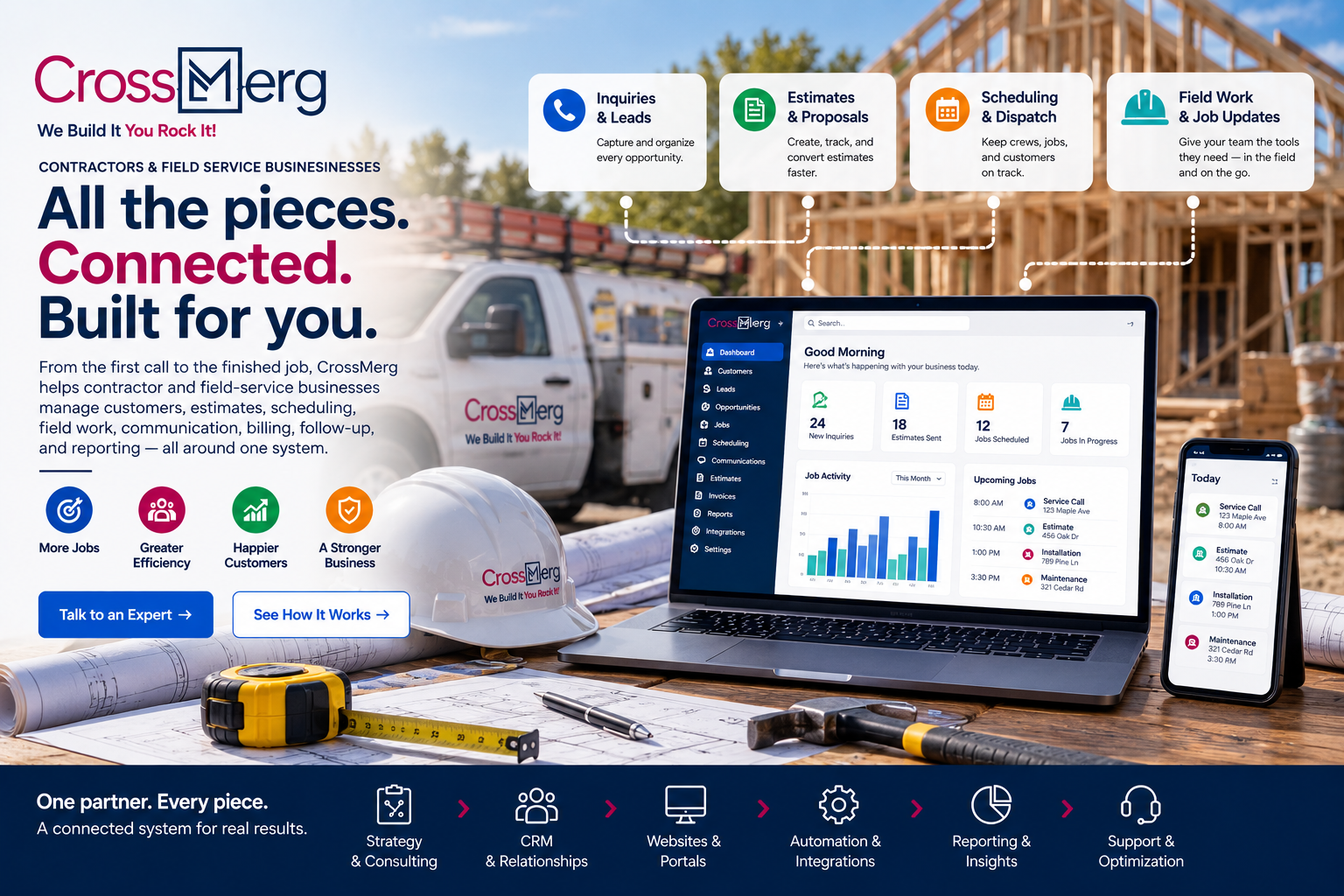
CrossMerg helps contractor and field-service businesses connect customer information, estimates, scheduling, field activity, communication, billing context, follow-up, and reporting around one managed system—with CRM at the center.

CRM-centered Built around real service workflows Keep useful tools already in place
CrossMerg managed business-system workspace for contractor and field-service businesses

Built around real service workflows

Contractor businesses do not usually have one software problem. They have a series of handoffs.

The customer experiences one company, even when the work moves between the office, estimator, scheduler, field team, billing process, and follow-up. CrossMerg keeps the customer record centered while those handoffs move forward.

  1. 01

    Inquiry

    Capture the customer, source, request, location, and the context the team needs to respond.

    Hands forward Usable lead context
  2. 02

    Estimate

    Keep scope, pricing, options, documents, decisions, and follow-up attached to the same relationship.

    Hands forward Clear proposed work
  3. 03

    Schedule

    Coordinate the appointment, crew, technician, project timing, or next operational commitment.

    Hands forward Owned next action
  4. 04

    Field Work

    Carry customer and job context into active work without creating another disconnected information silo.

    Hands forward Visible work status
  5. 05

    Invoice

    Keep billing context, documents, status, and customer communication connected to the completed work.

    Hands forward Cleaner financial handoff
  6. 06

    Follow-Up

    Use service history, reminders, reporting, reviews, maintenance, renewal, and future opportunity context.

    Hands forward Stronger customer continuity

Choose your industry

Start with the contractor workflow that looks most like your business.

Each industry page applies the same connected-system approach to the work patterns, customer handoffs, and operating signals that are most common to that trade.

Industry solution

Electrical Contractors

Connect inquiries, estimates, scheduling, service activity, customer communication, field handoffs, follow-up, and reporting.

Workflow signals Leads • Estimates • Service Calls • Follow-Up
Explore Electrical Solutions
Industry solution

Plumbing Contractors

Keep service requests, estimates, dispatch, scheduling, customer updates, job history, billing context, and follow-up connected.

Workflow signals Requests • Estimates • Dispatch • Service History
Explore Plumbing Solutions
Industry solution

Construction & General Contractors

Bring inquiries, opportunities, estimates, projects, documents, approvals, customer communication, and next steps into one clearer operating flow.

Workflow signals Leads • Estimates • Projects • Documents
Explore Construction Solutions
Industry solution

HVAC Contractors

Connect service demand, estimates, appointments, technicians, customer history, seasonal follow-up, and business visibility around the CRM.

Workflow signals Service • Scheduling • Technicians • Follow-Up
Explore HVAC Solutions
Industry solution

Cleaning Services

Organize inquiries, quotes, recurring work, scheduling, customer communication, service history, team handoffs, and follow-up.

Workflow signals Quotes • Recurring Work • Scheduling • Teams
Explore Cleaning Solutions
Industry solution

Roofing Contractors

Keep leads, estimates, inspections, projects, crews, customer updates, documents, and follow-up connected from opportunity through completion.

Workflow signals Leads • Estimates • Projects • Crews
Explore Roofing Solutions
The contractor operating system

Put CRM at the center, then connect the parts that need to move with the customer.

CrossMerg does not require every contractor business to use the same stack. The shared model is simpler: keep customer context dependable, connect the important handoffs, and improve the surrounding tools when the value is clear.

Operating center

CRM + Customer Context

Customer history • ownership • opportunities • work • communication • billing context • follow-up

Lead & request intake

Website forms, calls, referrals, and other requests can enter one consistent customer record.

Estimates & approvals

Keep pricing, scope, approvals, files, and customer decisions tied to the opportunity and relationship.

Scheduling & assignments

Coordinate appointments, crews, technicians, projects, ownership, and the next promised action.

Field & project activity

Keep notes, photos, documents, status, tasks, and internal handoffs connected to the customer.

Customer communication

Give the team useful history so updates, reminders, approvals, and follow-through do not start from scratch.

Workflow automation

Use focused triggers, assignments, reminders, approvals, and follow-up where repeatable work benefits from consistency.

Billing context

Keep invoice and payment status visible alongside the relationship and the work that created it.

Reporting & visibility

Turn connected operating history into practical visibility for pipeline, workload, follow-up, revenue, and business health.

Managed by CrossMerg.

Planning, configuration, integrations, hosting, support, training, reporting, and future improvements can remain connected to the system after launch.

Keep the tools that already work

A connected contractor system does not require a forced replacement project.

Estimating, accounting, scheduling, email, website, field, or trade-specific tools can stay when they still do their job. The goal is to reduce the gaps around them—not replace software for its own sake.

01

Keep

Identify the systems the team already trusts and the business still benefits from.

02

Connect

Move only the information, ownership, or next action that genuinely needs to cross a system boundary.

03

Improve

Fix the workflow or customer experience where real use shows the current process is holding the team back.

04

Automate

Automate repeatable handoffs only after the underlying process is clear enough to deserve automation.

Questions before you choose a contractor solution

Start with the operating problem—not a predetermined software stack.

These questions clarify how existing tools, CRM, automation, field work, websites, and ongoing support can fit together without forcing an all-at-once rebuild.

Contractor decision guide

Four principles make the starting decision easier.

Start with the workflow

Choose the real friction

Begin with the handoff that is costing the team the most time, clarity, follow-through, or customer confidence.

Keep useful tools

Connect before replacing

Scheduling, accounting, estimating, email, website, or field tools can often stay when they still serve a useful purpose.

CRM stays centered

One customer record

Customer history and ownership should remain visible while work moves across estimating, scheduling, field activity, billing, and follow-up.

Grow deliberately

Add the next layer when useful

Automation, reporting, portals, integrations, website improvements, and deeper support should earn their place in the operating model.

Do I have to replace the estimating, scheduling, accounting, or field tools we already use?

No. CrossMerg starts by identifying what is already useful, where customer or job context gets lost, and which handoff is creating the most friction. Existing tools can remain when there is a practical reason to keep them.

How do I know which contractor solution page fits my business?

Start with the industry that most closely matches how you sell and deliver work. The industry pages focus on the workflow patterns most common to that trade while keeping the same CRM-centered CrossMerg operating model underneath.

Does every contractor business need automation?

No. Automation is useful when a repeatable trigger, reminder, assignment, approval, or follow-up should happen consistently. We map the business handoff first and automate only when it creates clear operational value.

Can office staff and field teams use the same customer information?

That is one of the main goals. The exact implementation depends on the tools involved, but the operating model is designed to keep the customer, work history, ownership, documents, communication, and next actions connected across the business.

Can CrossMerg connect our website to the contractor workflow?

Yes. Website inquiries and service requests can be structured so useful customer context enters the CRM and can move into estimating, scheduling, communication, and follow-up without requiring the team to rebuild the same information manually.

What happens after the first system improvement is live?

CrossMerg can remain involved through managed CRM services, integrations, reporting, hosting, support, customer success, website improvements, and future workflow phases. The next layer is added when real use shows a clear reason for it.

A practical first conversation

Bring us the handoff that is making the day harder than it should be.

It might be lead follow-up, estimating, scheduling, field communication, job visibility, billing context, customer updates, or the way those pieces connect. We can help identify the smallest useful improvement and which industry solution should guide the next step.

No forced all-at-once replacement No contractor-wide intake form competing with industry pages No need to redesign every workflow at once

What we can work through together

01

Review where customer or job context is being lost, repeated, delayed, or rebuilt by hand.

02

Identify what should remain in place and which handoff should connect more cleanly to the CRM.

03

Choose the industry-specific path and first implementation phase that creates the clearest practical relief.

Not sure which contractor solution fits? Start with the workflow that is causing the most friction—we’ll help you find the right path forward.

Contractors & Field Service Businesses

Start with the workflow your team wants to make easier.

Tell us what happens from the first inquiry through the finished job and where the handoffs begin to break down. We can help route you to the right contractor solution and the smallest useful starting point.

Why businesses trust CrossMerg

Practical systems. Clear ownership. Human support.

We help teams improve the client experience without adding unnecessary complexity, forcing a large migration, or losing sight of how the business actually works.

Practical value

Why teams choose CrossMerg

  • Fewer status calls because clients can see what’s happening.
  • Faster approvals because the next step is obvious.
  • Cleaner payments because invoices have context and history.
  • A more professional client experience without enterprise complexity.

Founder perspective

A note from the founder of CrossMerg

If you tell us what your clients struggle with today — approvals, payments, scheduling, status updates, or disconnected processes — we’ll recommend the smallest practical step that can make a meaningful difference.

We focus on improvements teams can actually adopt, not abstract features that look impressive in a demo but create more complexity in day-to-day operations.

Our starting point Find the smallest practical improvement that creates meaningful value.

How we work

How we build better client experiences

Client-first language

We translate internal workflow into simple client-facing steps that reduce friction.

Lightweight rollout

Start with one feature before rolling out deeper portal options.

Works with your reality

We respect your team size, tools, and capacity — no forced big-bang migrations.

Start small and expand later. No long-term contracts or surprise fees. Built and supported by a small, US-based team.